Showing posts with label Ruins-and-Ronin. Show all posts

Sunday, April 3, 2011

Mu-Pan - Encounter XVIII

So begins the day of too many posts! First up - another encounter for Mu-Pan. Later, I wade into the ABC challenge thing and later I'm going to post a few new monsters for Ruins and Ronin.

--

1611. A number of winding catacombs are dug into the side of the mountains here. The catacombs run for several miles, have arched ceilings and are lined with shelves (3 feet off the ground, 3 feet deep). The floor of the caverns are cut to allow water to flow down the center, and small streams do run from the catacombs. The entrance to the catacombs is protected by a bronze portcullis that can only be opened by playing a hunting melody on a bamboo flute (or by physical force - requires 2 hours of pounding with weapons or a combined strength of 60 to pull open).

The catacombs contain numerous skeletons wrapped in leather and tied with silken cords. Several of these bodies seem to shift as one walks past them - a trick caused by thin trip wires. At each juncture of the catacombs, there hangs a bronze temple bell by a red cord. When a bell is passed without being rung, the corpses in the tunnel the adventurers have just left animate as skeleton warriors, crawling from their wrappings and relying on their claw-like finger bones to attack. There are 1d10+7 skeletons in each tunnel. Ringing a bell after the skeletons have animated does nothing.

The main inhabitant of the catacombs is Bzisfisihm, a poet and high priest of the shamshir who died over 1,000 years ago. His main tomb is located in the center of the catacombs. The tomb is preceeded by an antechamber with three red doors. The center door leads into a small chamber with a collapsible floor. Beneath the floor is a stone chute that is both covered in oils and embedded with shards of glass. Those falling down the shaft suffer 2d6 points of damage minus their total armor bonus. They are deposited in a small stone tomb, already piled high with bodies.

The other two doors lead into the tomb proper. The tomb is clad in red stone and features a white, marble dais in the center surrounded by a dozen terracotta warriors. Atop the dais there is a gaudy sarcophagus of marble and brass containing the body of Bzisfisihm wrapped in red silk and tied with golden cords (worth 100 gp). Set in the mummified remains of the high priest there is a tiger's eye gem. This gem contains the high priest's spirit, which can leave the gem to inhabit and animate the terracotta warriors.

The lid of the sarcophagus is heavy, requiring a combined strength of 30 to lift and move about. If placed flat on the floor, it becomes a doorway into a pocket dimension containing the high priest's treasures. The pocket dimension appears as a stone staircase descending 100 feet and emptying onto a small island seemingly floating in space. The "walls" of the island, though invisible, do exist, and strange creatures can be seen beyond those walls, some noticing the adventurers and moving to glare at them from the walls, like curious children or hungry dogs.

This island/room contains a stout, iron chest embedded with 2-inch long spikes. The chest is locked and trapped - should one walk away from the chest, it fires its spikes throughout the room (1d4 attacks person from 2 HD creature, 1d4 damage each), accompanied by a blinding flash of light (save or blinded for 1d4 hours). Inside the chest there are a number of large aquamarines - one for each adventurer and two of each shape - circle, oval, square, triangle, etc. Each aquamarine is worth 500 gp, but they are cursed. The two holders of the same shape have their spirits switched - in effect, the players trade character sheets. The only way to switch bodies back is to bath in foamy surf of the Sea of Stars at sunset.

| Terracotta Warrior: HD 3; AC 3 [16]; Atk 1 slam (1d6+1); Move 9; Save 14; CL/XP 3/60; Special: None.

Wednesday, March 30, 2011

A Bevy of Bujin

As regular readers know, my Mu-Pan hexcrawl is based on Mike Davison's excellent Ruins and Ronin ruleset (and by reading this sentence, you are now contractually obligated to go buy it - sorry, the law's the law).

R-n-R is, in turn, based on Swords and Wizardry White Box, so it keeps things simple. There are four classes - Bujin (fighting-man), Sohei (cleric), Shugenja (magic-user) and Half-Ogre. In addition, Mike has released the Ninja, Kensai, Headhunter and Henyeyokai classes on his blog. The bujin is, essentially, a samurai that can make use of the heaviest armor in the game and any weapon.

Unfortunately, Mu-Pan is based as much on China as Japan, and that leaves a few gaps where fighting-men are concerned, primarily in the form of the shaolin monk. Of course, there's a perfectly good monk in NOD 1 and S-n-W Complete, but I decided I wanted to minimize reliance on other rulebooks when writing Mu-Pan. Besides which, there are some important differences in terms of Hit Dice between White Box, Core and Complete. To that end, I came up with this little system for modifying the existing bujin to model different kinds of Asian warriors, from wandering swordsmen to fighting monks to members of dart bureaus.

Keep in mind, this is a rough draft. I'd love to hear comments on the concept.

The bujin as written is designed to be a heavily armored warrior, serving on the front lines of an adventuring band, his o-yoroi armor deflecting deadly blows while his flashing katanas cut down foe after foe. This is a fine archetype of Asian fighting prowess, but it stands at almost the opposite end of the spectrum from Asia's other great fighting archetype - the unarmed martial artist. To model your bujin as something other than a samurai, this houserule permits you to reduce your allowable armor in return for a special ability. The less armor you are permitted (and thus the more damage you're likely to take in combat), the more special abilities you can have.

Maximum Armor Bonus | Special Abilities
+0 | 4
+2 | 3
+4 | 2
+6 | 1

Special Abilities

Combat Sense - You are normally surprised on a roll of 1 on 1d8 and can make a saving throw to avoid back stabs from ninjas and thieves.

Deflect Missiles – Once per round, you can make a saving throw to avoid an otherwise successful missile attack.

Estimate Foe - For each round you do not attack your opponent, you gain a +1 bonus to hit, Armor Class and damage for the remainder of the combat against that opponent.

Headlong Charge – You run at an opponent or ride at an opponent and attempt a single attack at a +2 bonus to hit along the way. You must run at least 20 feet to use this ability, and you suffer a -2 penalty to your AC during any round in which you make a headlong charge.

Fists of Iron – Your unarmed attacks do 1d6-1 (1d4) points of damage.

Flurry of Blows – You can make one attack against a secondary opponent every other round.

Iron Hold - With a successful attack you wrap your opponent up using your arms and even legs; equivalent of a hold person spell until your opponent makes a successful saving throw (penalty equal to difference between your strength and their strength). If your attack fails, you suffer a 1 point penalty to Armor Class until your next turn.

Ki Shout – You harness all your power and put it into a single melee attack, gaining a +2 bonus to damage if you hit. You can unleash a ki shout only once per day.

Mighty Leap – You can make a 6 foot horizontal and 3 foot vertical leap if heavy encumbered, 8 foot / 4 foot leaps if lightly encumbered and 10 foot / 5 foot leaps if unencumbered.

Mounted Archery - You suffer no penalties to firing a bow from an unsteady platform, like a boat, horse, flying carpet, etc.

Parry Blows – You can trade an attack during a round for a +1 bonus to your AC or the AC of a creature or object no more than 3 feet away from you.

Parry Death Blow – Once per combat you can make a saving throw to retain 1 hp when a successful blow would otherwise have killed you.

Swift Motion - You roll a separate initiative from your group, and may take whichever initiative roll is better. Your movement rate is also increased by three.

--

Image by Wayne Reynolds via Paizo. I'm a WAR junkie, so when I saw this image pop up today on their blog, I had to appropriate it.

Monday, March 28, 2011

Mu-Pan - Encounter XVI

Had some homework to do with my daughter tonight (designing a Harry Potter game for school), so no Megacrawl today - hopefully tomorrow. In the meantime, enjoy another Mu-Pan encounter ...

1425. A pagoda has been constructed here from round, pearly stones that don't appear to be held together by any sort of mortar. The pagoda's roofs are made of a bronze-colored wood that shimmers in the daytime. Inside the pagoda there is a pit that burns with purple-black fire. The flames rise to about 10 feet, but flare when living creatures approach. At night, the pagoda gives off a glassy, purple glow to a distance of about 100 feet (double that when living creatures are nearby). At night, encounters with undead monstrosities occur on the roll of 1 on 1d6 made every hour. Use the following table to determine what dark pilgrim visits the pagoda.

Roll | Monster
1-2  | Zombies (1d6+6)
3-4  | Jikininki (1d3+3)
5-6  | Ghouls (1d3+1)
7     | Gashadokoru (1d3; see monsters)
8     | Kyonshi - Hopping Vampire (1d2)
9     | Shikki-Gaki (1)
10   | Jiki-Ketsu-Gaki (1)

__

Image by Edmond Dulac

Sunday, March 27, 2011

Mu-Pan - Encounter XV

A wizard's tower high in the mountains ...

1244. The top of a mountain has been carved, or possibly molded, into a slim tower that overlooks its surroundings for 18 miles (3 hexes). The master of this house is Zabrasha, an elementalist and sworn enemy of the men of Tsanjan. Her presence here has long been a thorn in their side, but as yet they have mounted no serious attack on her citadel.

The citadel looks like a needle of gray stone piercing the heavens. In fact, the "needle" is about 200 feet in diameter and 300 feet tall. Nestled in this massive citadel are 99 chambers, each decorated in a different color (some repeat) and each holding a small shrine to an elemental spirit. Zabrasha's servants, about 20 kobolds with gleaming scales and five apprentices, keep incense burning at the shrines and make daily chants before them. The entrance to the tower is gained by climbing a long, winding stair about 500 feet up the side of the windy mountain. The stairs end in a 20-ft long tunnel that opens into an enclosed courtyard with three bronze doors. The side doors lead spartan quarters that the Gray Lady makes available to petitioner and travelers. These rooms contain bronze braziers for warmth, sleeping mats and pegs for hanging belongings, but nothing else. The other door is guarded by two ishidzukui-shishi (HD 5+2; 19, 16 hp).

The base of the tower's mountain is covered in a thick woodland of stunted poplars, birches, walnuts and wild cherry trees. The area is rich in game animals (deer, mountain pigs, shaggy hares) that the kobolds trap and the apprentices prepare. Both apprentices and kobolds wear conical hats made of rabbit hide. A neglected town hides in those woodlands. It is inhabited by two dozen hunters and their families and holds only one building of note, a crumbling tower that holds an ancient altar dedicated to the Panda Emperor.

Zabrasha is an elderly woman with gray hair, gray eyes and tawny skin. She has a delicate build and a deeply creased, though still attractive face. While kindly at heart, she is always on guard for her enemies and she is a harsh mistress with her apprentices, believing that tough love will save them in the future as they attempt to deal with elementals and other extra-planar creatures of great power. An old romantic, she falls in love easily, especially with older bujin that remind her of her first husband and partner in adventuring.

Zabrasha's treasure consists of 950 sp, 770 gp and a diamond worth 800 gp.

| Apprentice, Elementalist Lvl 1: HP 1d6; AC 9 [10]; Save 15; CL/XP B/10; Special: Command spirits (4/day), turn elementals. Equipment, grimoire, tools.

| Zabrasha, the Gray Lady, Elementalist Lvl 10: HP 27 [31]; AC 9 [10]; Save 8; CL/XP 12/2000; Special: Command spirits (8/day), turn elementals. Equipment, grimoire, tools.

Note: If you do not wish to use the elementalist class from NOD 3, substitute with the shugenja.

-

Image from Wizards of the Coast website.

Saturday, March 26, 2011

Mu-Pan - Encounter XIV

Do you like crane maidens?

Well, probably not these crane maidens ...

1226. Warm springs flow from the mountains here, a cluster of largely dormant volcanoes. The gorges that lead into the wooded valley are crusted with mineral salts, but the go uncollected, for the gorges are sacred to the demon god Chiyou and visitors are not permitted in the valley.

At the heights, there is a large pool of warm water surrounded by junipers and dusty purple thistles. The pool is inhabited by 1d6+4 vapor cranes. In the center of the pool there is an ancient marble cistern filled with warmer water and five crane maidens, sisters and daughters of Chiyou. The crane maidens are not physically very powerful, but they have two unique powers. When their eyes grow scarlet, they cause the water to boil (1d6 damage per round). When they glow purple, the water becomes as solid as concrete for 3 rounds.

| Vapor Crane: HD 5; AC 4 [15]; Atk 1 bite (1d4+5); Move 6 (F12); Save 12; CL/XP 6/400; Special: Scalding to touch, steam cloud (1d6+5) in cone or 15-ft radius.

| Crane Maiden: HD 2; AC 5 [14]; Atk 1 strike (1d4); Move 15 (F30); Save 16; CL/XP 4/240; Special: Magic powers, change into crane (heals all damage, 2/day), magic resistance (30%).

--

Image by Hsu Roh Ling

Mu-Pan - Encounter XII / XIII

Short encounters tonight, so I'll post two ...

1025. A flock of seven cheonma have made an aerie for themselves on the high peaks here and are under attack by a pack of five griffons. The cheonma are hard pressed and they have already lost two foals to the depredations of the griffons.

| Cheonma: HD 4; AC 6 [13]; Atk 2 hooves (1d8); Move 24 (F48); Save 13; CL/XP 4/120; Special: Flight. Cheonma are Mu-Panese pegasi. They are eight-legged horses with wings on their feet.

| Griffon: HD 7; AC 3 [16]; Atk 2 claws (1d4) and bite (2d8); Move 12 (F27); Save 9; CL/XP 8/800; Special: Flight.

1027. A gang of 20 gyres is occupying a cave here, using it as a base of operations as they raid down the river into Yun territory. The leader of the gyres has a single white eye and particularly long canine teeth. He wears a golden ring on one of those teeth (worth 15 gp) and can cast 1d6 levels of sohei spells per day. The gyres wear coats of leather scales and wield masakaris and kamas. If encountered in their lair, there is a 2 in 6 chance they are drunk on plum wine. Their treasure consists of 340 sp and 1,130 gp in leather sacks. The stripped bones of two unlucky farmers are piled in the back of the cave.

| Gyre: HD 2; AC 4 [15]; Atk 1 bite (1d3) and 2 claws (1d4) or weapon (1d6); Move 15; Save 16; CL/XP 3/60; Special: Frenzy (2 attacks per round for 3 rounds, then fall unconscious).

Thursday, March 24, 2011

Mu-Pan - Encounter XI

Man I love writing this stuff - just letting my mind wander, maybe feeding it with a few random seeds. Here's another one from the mountains around Tsanjan ...

0937. A small village of fishermen live in this hex in a gorge with steep, 90-foot tall sides. A river moves slowly through the hex on its way to the Tsanjani Plateau. The fishermen dwell in something that resembles a Chinese lantern composed of rattan and attached to the walls of the gorge with iron spikes. Each lantern-house measures about 6 to 9 feet in diameter and houses three or four villagers. The fishermen can be seen at odd intervals dangling their feet out their front doors casting long lines into the river below. Hatches in the tops of the lantern-houses lead to ladders composed of iron spikes, allowing the villagers to climb to other lantern-houses or to the top of the gorge.

Below the lantern-houses an idol of Yarni-Zai has been carved into the gorge wall. The grave creator of beasts and men broods over the slow river, which the villagers believe was originally a beautiful maiden that won the heart of the deity but refused him. A hermit priest sits in the lap of the graven image, meditating, answering the questions of the villagers and curing their ills as best he can. The hermit has no name, and asks nothing but an offering of rice or fish in his begging bowl.

The villagers are armed with yami and haikyu, though their lack of money keeps the bandits away and their somber attitude and resignation to the indignities of the world make them unlikely targets even for chaotic adventurers.

| Hermit, Druid Lvl 6: HP 12 [23]; AC 9 [10]; Save 9; CL/XP 7/600; Special: Spells (3rd), speak to animals, plants and monsters, shapechange. Begging bowl, prayer beads.

---

Image from HERE.

Wednesday, March 23, 2011

Mu-Pan - Encounter X


0824. A stone tower made of golden bricks leans over dangerously from the side of a low mountain covered in a tangle of brambles. The tower is the lair of a wang liang and his foot soldiers, 40 oni-yama. The wang liang owns an enviable library of bamboo scrolls on every imaginable subject, though every single one of them is filled with nothing but lies and half-truths. One of the scrolls contains a number of spells that appear to be one thing but are in fact another: Charm person (actually light), invisibility (actually levitate) and alter time (actually lightning bolt).

Tuesday, March 22, 2011

Mu-Pan - Encounter IX

Another one from Mu-Pan. You'll notice I haven't done the treasure yet. I use an excel document to randomize treasure. The tables are based on those from Swords and Wizardry, and yesterday I was too lazy to open it up and generate the goods, mostly because Open Office doesn't handle it as well as excel does and I usually work on my laptop. I know - who cares. Anyhow ...

0718. A cliffside monastery in this hex was abandoned about 30 years ago when the monks were masacred in an attack by oni-aka goblins. Twenty of the goblins still dwell in the place, though they avoid the shrine. The goblins are led by Iki-Urha, an ogre with rust-colored, heavily creased skin and a bulbous nose.

The monastery shrine was dedicated to the concept of Law. The rear wall of the shrine, which measures 15 feet by 15 feet, is covered with bronze clockworks that approximate the movements of the cosmos - at least those of Nod and the planets Luna, Mercurii, Veneris, Martis and the Solar Sphere. The shrine is protected by four giant, clockwork owls perched on bronze bars that run the length of the shrine.
The goblins and ogre have desecrated the remainder of the monastery. The ogre has a single prisoner, a musician named Zeaho. Zeaho is the last survivor of a party of adventurers that sought out the monastery under the direction of their lawful sohei. Zeaho is a hengeyokai that can assume the form of a hare.

The ogres and oni-aka have a treasure of XXX in a large, locked chest.

| Oni-Aka (20): HD 1; AC 6 [13]; Atk 1 weapon (1d6); Move 9; Save 17; CL/XP 1/15; Special: Resistance to fire (50%).

| Clockwork Owls (4): HD 4+1 (19, 15, 14, 9 hp); AC 2 [17]; Atk 2 talons (1d6), bite (1d6+1); Move 6 (F30); Save 13; CL/XP 5/240; Special: Immune to sleep and charm, resistance to cold and fire (50%).

| Zeaho, Hengeyokai Bujin Lvl 4: HP 14 [22]; AC 9 [10]; Save 13 (12 vs death & poison); CL/XP 4/120; Special: Follow through. Pipe (a lute).

| Iki-Urha, Ogre: HD 4+1 (17 hp); AC 5 [14]; Atk 1 tetsubo (1d6+3); Move 9; Save 13; CL/XP 4/120. Tetsubo, nine-ring broadsword (belonged to Zeaho).

--

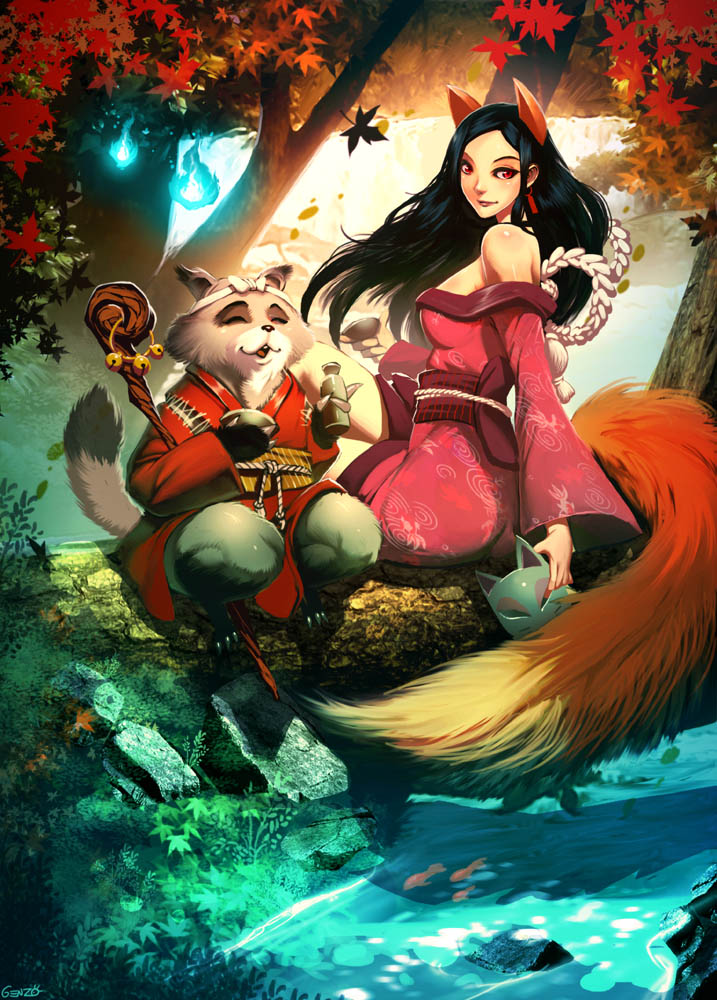
Image of bakeneko and tanuki by GENZOMAN at DeviantArt. Much to see in his gallery.

Monday, March 21, 2011

Mu-Pan - Encounter VIII

One more before I post the update to Megacrawl 3000 ...

0443. Three one-eyed boys (hitotsumi-kozo) dwell in this hex in a cave studded with sapphires (worth 100 gp each, a total of 23 are present). The cave is set in the side of a long hill, the base of which is cluttered with goji berry bushes. The one-eyed boys gather the goji berries and mash them into juice that they ferment in clay pots buried in the floor of their cave.

Although removal of the sapphires is very tempting, it is a dangerous thing to do. If a sapphire is plucked from the wall of the cave, a blue ray erupts from the wall and strikes the person holding the sapphire (no roll needed). The ray always strikes the person in the forehead and sets up a communication between the thief and something from beyond the void (per the contact other plane spell). The experience leaves most people a bit jumbled (1d8 points of ability damage spread between intelligene, wisdom and charisma as the player prefers). This damage can be healed with magic (restoration), but will not heal naturally.

If all of the sapphires are stolen from the cave, the rays create a portal through which 1d6+4 star warriors emerge. The star warriors are hairless humanoids with translucent, sapphire skin and eyes and wearing long, metallic coats of miniature scales (the material is aluminum - light weight and quite strong) and carrying two war hammers each. The star warriors track down the sapphire thieves and return them (the sapphires) to the cave. The thieves are either killed or they are taken back to the cave and taken through the portal.

| Hitotsumi-Kozo: HD 3; AC 6 [13]; Atk 1 weapon (1d4); Move 9; Save 14; CL/XP 7/600; Special: Bad luck, frightful appearance, ray of enfeeblement, silence, true seeing.

| Star Warrior: HD 5; AC 1 [18]; Atk 2 hammers (1d6); Move 12; Save 12; CL/XP 5/240; Special: Track sapphires unerringly, immunity to cold, ESP at will.

--

Also - to avoid confusion when talking about the Cloud Dragon, Gold Dragon etc kingdoms and the monsters of the same names, I've given the kingdoms alternate names:

Jin - Gold Dragon Kingdom
Meng - Mist Dragon Kingdom
Ying - Shadow Dragon Kingdom
Yun - Cloud Dragon Kingdom

Of the kingdoms, Meng no longer exists (at least, not in a normal way), its citizens now serving as the empire's merchant class based in the coastal cities.

Saturday, March 19, 2011

Mu-Pan - Encounter VII

0421. An army of 270 oni-aka (red goblins) raiders has encamped in this hex. The army is preparing to sack the city-state of Pantung [0322]. The raiders are working on behalf of a cabal of villains (an ogre magi, sorcerer ox and evil naga, themselves the puppets of an oni. The raiders are under the command of the hobgoblin marshal Valtrahar. Valtrahar rides atop a palanquin carried by four ogres. He wears a black bronze jingasa with a porcelain mask that bears starched whiskers. He is accompanied by a hired shugenja called Imyneda, a melancholy woman with fulvous skin, gray-green eyes and dark brown hair in braids. Imyneda has a large woman with a round, bland face who complains incessantly as she rides along on her yak. The army has three trebuchet pulled by teams of yaks.

| Valtrahar: HD 6 (34 hp); AC -1 [20]; Atk 1 weapon (1d6+1); Move 9; Save 11; CL/XP 6/400. O-yoroi, no-dachi, tanto.

| Imyneda, Shugenja Lvl 5: HP 13 [20]; AC 9 [10]; Save 11 (9 vs magic); CL/XP 4/120; Special: Spells (3rd). Bo staff, tanto, spellbook.

--

Picture found HERE.

Mu-Pan - Encounter VI

The fun of randomizing hex contents is, of course, that I don't know what's going to pop up and I have to try to make it fit (or delete it and pretend it didn't come up). In this case - surprise, there's a city in the high mountains!

0322. Pantung is an outpost city-state of 12,375 souls constructed between three dormant volcanoes. The clever engineers of Pantung have dug into the volcanoes, constructing large vents from which pour air and water warmed within the volcanoes. This has made the valley of Pantung warm all year around, despite being located at such a high elevation. The borders of the kingdom are protected by walls of ice that slowly melt and are re-built through the year.

The city-state itself is constructed on a radial pattern. The buildings are made of thick, cream-colored stone, much of it excavated from the aforementioned vents. Doors in the city-state are barred at night, for the citizenry fear the hobgoblins and yeti of the mountains. The city’s wall is 30 feet tall and has four large tower keeps protecting it. Each 1,000 foot section of the wall (there are 16 such sections) and the battlements of each tower are patrolled by 1d6+6 handgunners accompanied by a sergeant-at-arms and possibly (10% chance) a low level shugenja. Each tower has a number of war engines that launch flights of iron war rockets. Three paved roads lead from the city state, one into Tsanjan, the other two into Mu-Pan. These roads are lined by asters ranging in color from white to golden yellow to bright purple.

The primary business of Pantung is copper mining (the city-state has small mines up to 3 hexes away) and banditry. During the winter months, dozens of bandit gangs retreat into the mountains to stay in Pantung, bringing rich tributes of coins and slaves to the nu-gong. The bandit chiefs are treated as visiting royalty. The bandits never prey on the citizenry, who appreciate their bawdy tales and ample coin. The fields around Pantung support cherry and plum orchards and grazing for a breed of rugged mountain pony. The primary coin of Pantung is made of bronze (i.e. copper piece), and the average earnings of a commoner is about 2 cp per day.

Pantung is ruled by Nu-Gong Oonichay, a respected shugenja with ties to the black magicians of Tsanjan. She is assisted by a cabal of 4 noble houses, each headed by a master alchemist. Oonichay is a calculating and domineering. She has pale skin, hazel eyes and dark, brown hair that is bobbed short. Oonichay is an accomplished dancer (she was brought into Pantung as a dancing girl for the former gong). She has a small-featured, delicate face that never betrays her thoughts. She wears a cloak of gray and black vulture feathers (from the bearded vulture of the Tsanjan Plateau). Her palace is in the city-state’s center, surrounded by the legendary fruit market. The palace dungeon is a thing of legend.

The city-state’s alchemists are respected (and, to some extent, despised) throughout Mu-Pan. They put most of their efforts into discovering the elixir of life, but also produce copious amounts of black powder (mostly to fuel the iron war rockets and handguns that protect the city from invasion)

Pantung’s patron deity is Roon, the god of going. Roon’s grand temple is overseen by 10 female nsiain (Mu-Panese druids) and 300 lay brothers and sisters, most of them piao-ke (guides, former bandits). The worship of other deities is frowned upon in Pantung, and proselytizing is illegal. The nsiain of Pantung take vows of poverty (though their temple is quite wealthy) and celibacy. The temple’s wealth is used to maintain the roads (and the flowers, the aster is sacred to Roon). Priestesses wear robes of green sackcloth marked by dozens of white hand prints and carry tetsubos. They bleach their palms white. Holy days are observed by the people and priests with pilgrimages to visit shrines (actually noble crypts) in the mountains. The highest virtues preached by Roon’s church are kindness and charity, the most terrible sins blasphemy and envy.

Pantung has a shady tavern located just inside the east gate. The Golden Staff is run by Isekonall, a friendly, optimistic man who hails from the northern steppe and speaks with a thick accent. Most of the crowd in the Golden Staff is shady – bandits and slavers, for the most part. The place is usually crowded and noisy. The plum wine and short beer that Isekonall serves are a bit overpriced for their quality, but the four rooms (actually a loft partitioned with paper screens) are cheap (and mostly occupied, 1 in 6 chance of a room being vacant).

Some of the more interesting folk of Pantung include Newarada, the strinkingly beautiful high priestess of Roon that is really a disguised man (a ninja of the Black Dragon Kingdom who has played the role for over a decade, he is involved in many assassinations), Snomonchond, a flamboyant master alchemist and open heretic (he worships Sol Invictus, whom the Motherlanders call Apollo Helios), Hagravet, the well-connected captain of the guard who keeps company with Snomonchond, Zajinnes, an arrogant master alchemist and rival of Snomonchond who has a family closet full of skeletons and an unhealthy fixation on Hagravet, and Aschansary, a young official implicated in a bribery scandal – she’s had bad luck with former allies and finds it difficult to place her trust in others.

Ruler: Oonichay, Nu-Gong (Duchess), Shugenja Lvl 8
High Priestess: Newarada, Druid Lvl 8
Population: 12,375
Domain: 10 hexes
Size: 1 mile diameter
Arms: Three black dots on a field of white

Wednesday, March 16, 2011

Mu-Pan - Encounter IV/V

Two more for wondrous Mu-Pan. I have decided to use the Gods of Pegana as the Gods of Mu-Pan. Should be fun. One of those Pegana gods also shows up in Hexcrawl Classics #1.

--

0232. A sect of lawful sohei dedicated to Kilooloogung, the Lord of Arising Smoke, has been established here in a deep valley rich in iron deposits. The mines are now worked by the lay brothers of the fortress monastery. The monastery is constructed of fired bricks. Each brick is stamped with a holy symbol and glazed red. A slow fire fed by fragrant herbs and woods is maintained at all times in the center of the monastery, the smoke escaping into the sky via three towering bronze chimneys made to look like dragons.

The abbot is called Jeneozen, a charming fanatic with dark yellow-brown skin and blue-gray eyes. Jeneozen is suffering under a curse that forces him to eat almost constantly, but still he loses weight. Once healthy and hale, he has become drawn and weak. The only cure for his condition, he believes, is a bitter, Y-shaped root from the Shadow Hills. Jeneozen commands ten lesser sohei.

Despite the dedication of the ten sohei of Kilooloogung to Law, the lay brothers of the monastery are a shifty lot - smugglers of dangerous narcotics from the high plateau of Tsanjan into the Celestial Hills. The lay brothers of the temple serve a hanu naga called Sebuthop of the Golden Scales (HD 6). She dwells in one of the abandoned iron mines, one that connects to a deep thermal vent, making it steamy and choked with fungal vines.

The monastery treasure horde consists of 19,300 sp, 730 gp.

| Sohei of Kilooloogong, Lvl 2: HP 2d6 [2d6+2]; AC 6 [13]; Save 13 (11 vs death & poisons); CL/XP 3/60; Special: Banish undead, spells (1st). Haramaki-do, sode, tetsubo (1d6), 3 darts, prayer beads.

| Jeneozen, Sohei Lvl 10: HP 8d6+2; AC 5 [14]; Save 5 (3 vs death & poisons); CL/XP 10/1400; Special: Banish undead, spells (5th). Haramaki-do (made of shark skin), sode, suneate, tetsubo (1d6), 3 darts, prayer beads.

0307. The mountains here are lightly forested with black alders. The slopes are home to thousands of locusts. A river of acid spills from a weird cave and down a series of waterfalls into a hole in the earth. Weathered granite pillars rise from the acid river at odd intervals. Above the cave from whence the river flows there is a small, shallow cave. Some ninjas of the Black Dragon Kingdom are trained here. The ninjas must leap from pillar to pillar, making their way up the river to the shallow cave to claim a random object. The object must be returned to the Black Dragon Chan within 3 months of the beginning of the test to pass. Those who fall into the river are either disintegrated by the acid or fall into the bowels of the earth. Those who fail to return to the Black Dragon Chan are hunted down and killed.

The cave and river are always watched by a dozen shadows, the souls of deceased ninja. Intruders into the gorge are attacked by these shadows at dusk or night, but not in the daytime. There is also a 1 in 6 chance that a band of 1d6 ninja are encountered in the gorge. If there is a single ninja, you can assume they are taking the test.

--

Image from Stravag via DeviantArt.

Saturday, March 12, 2011

Mu-Pan - Encounter II/III

Missed a day, so two Mu-Pan encounters today. Just click on the Mu-Pan tag at the end of the post to find other posts, including a map.

0129. A small village of loutish hunters is located in this hex, surrounded by a stone wall and four stout towers. The hunters are mainly trappers, setting snares in the mountain passes and wooded crevasses in the spring and summer and then retiring into their village to smoke their pipes and chew eat pickled meat. The villagers are skilled gamblers and even more skilled archers. Their greatest treasure is an opal jar that contains the imprisoned soul of an oni. The jar is kept in the crypt of the former ruler, a tsanjani monk that made a habit out of chaining the maidens of the village to the walls of his shrine and watching them slowly starve. The villagers do not miss the man and have done their best to prevent the tsanjani from discovering the death of their reeve.

0213. A large village of tsanjani peasants cultivates edible fungus in the steamy caves that line the walls of the valley. Pungent streams of piping hot water emerge from these caves and spill into medicinal pools, eventually finding their way into a gentle stream that flows into the valley of the qal. The village is surrounded by an ancient, weathered stone wall caked with sulfur. The village is ruled by an overbearing magistrate of the tsanjani named Quatherennee. Quatherennee has pale yellow skin, stubbly gray hair and steel-gray eyes. The village is defended by two companies of men-at-arms (archers and heavy infantry) as well as semi-tamed white babboons. The babboons are chained near the village's large iron gate and outside the magistrates court. Patrols of warriors always use one or two babboons as scouts. Visitors can hire out Shoolinsth the piao-ke (armed escort) to guide them through the mountains.

| Shoolinsth, Bujin Lvl 5: HP 12 [32]; AC 3 [16]; Move 12; Save 12 (11 vs. death & poison); CL/XP 5/240; Special: Follow through. Hanburi, sode, kota, do-maru, suneate, nodachi (1d6+1), tanto (1d6-1), daikyu (100', 2 shots per round, 1d6), 10 leaf head arrows, 10 armor-piercing arrows, 3 frog crotch arrows.

| Quatherenee, Aristocrat: HD 3 (8 hp); AC 5 [14]; Atk 1 weapon (1d6); Move 12; Save 14; CL/XP 3/60.

Thursday, March 10, 2011

Mu-Pan - Encounter I

In the past, I have generally grabbed several encounters and posted them on the blog as a preview/freebie of my latest Nod sandbox. This time around, I'm going to use the 1 in 6 rule. Currently, I'm writing a few different supplements - Tome of Horrors Complete, Mu-Pan Hex-Crawl and Mystery Men! To keep up with them, I figure out in advance how many total "encounters" I need to write, figure out when I want to be done and then divide to figure out how many encounters a day I need to write. The key, of course, is to sit down and write every single day, even when you don't want to.

For example, if I do about 4.5 monster conversions/encounters a day for Tome of Horrors Complete, I can finish the book by the end of March. In fact, I'm doing 6 a day to stay ahead of the game. Likewise, I'm trying to do about 6 encounters a day for Mu-Pan. My plan is to pick one encounter each day (rolled randomly, of course) and post it on the blog. For Mystery Men's Shore City, I've actually been doing next to nothing - still need to draw the official map and figure out how to do a city-crawl. I think I'm going to do it block x block, classify the blocks as "downtown", "industrial", "suburban", "waterfront" and then include some general urbo-morphs for the different types of cityscape. When I do it that process up and running, it will work on the same principle.

To go along with the Mu-Pan posts, I'll be highlighting some of the more interesting bits of Asian art I've collected. They won't always have anything to do with the encounter of the day, but c'est la vie. The encounter of the day for Mu-Pan is ...

0113. Situated high in the mountains there is a small village of barbaric hunters. The village consists of about 20 wattle-and-daub houses surrounded by a palisade. The village is constructed on a wide shelf of black stone situated beneath a snow-capped peak. Due to the possibility of avalanches, and the necessities of hunting, the people of the village have learned never to raise their voices.

The barbarians of the village dress in shaggy, white coats and wear fur-lined boots. They have buff-colored skin and coarse black hair. The 60 hunters of the tribe paint their faced and knuckles with viridian paint. They are known for their brawn (+1 to hit and damage) and ability to move silently (they surprise in a roll of 1-2 on 1d6). The hunters carry bunches of six javelins and obsidian knives. They are commanded by a powerful chief called Narikit.

In the past month, a captured merchant (taken in a raid on the outskirts of the valley of the qal [XXX]) has captured the heart of the chief's daughter, Dagusta, much to the chagrin of Hargene, the warrior who captured the merchant.

The tribe's treasure consists of 900 gp worth of animal pelts.

--

Again, you'll notice an "XXX", this time as a placeholder for the hex number of a qal settlement. [Aside - don't like the name of the qal - need to work on it].

Oh, and I think I've named my rivers:

West 1 = Puar-Sronjj ("String of Pearls")
West 2 = Tauku ("Jade Tiger")
West 3 = Maoukun ("Maiden")
West 4 = Ronj ("King")
East 1 = Sonossur ("Left Hand")
East 2 = Ciphur ("Copper")
East 3 = Jruas ("Great")

The language is imaginary - actually I use the language mixer at Chaotic Shiny (my favorite random generator site, if it must be known) using "melodic 1" and then altering things as I see fit.

Sunday, March 6, 2011

On Mu-Pan, Part One

Okay, let's get this Mu-Pan thing started.

So far, I've finished the base map and the history of the region and I'm working up the regional descriptions. I'm going to put the information down here as I've written it so far. Some folks have asked "how do you write your stuff". You'll see in what I have so far that, as I start writing a region, I leave a few bits blank. The rivers, for example, have no names yet - I just haven't decided on them yet. You'll also find a few XXX's in the text. When I'm writing and I want to skip something to refer back to later, I use XXX. That way, I can do a quick search in a document for "XXX" to find those things and fix them before publishing.

I also realized as I was writing it that I needed to gather some intelligence on the flora and fauna of China and Japan. Actually, I highly suggest anyone doing a campaign setting hit the encyclopedias (or wikipedia) first - start with a search for a region and then just begin exploring everything. Look for interesting words, strange peoples, strange objects, etc. The idea is to produce something memorable to people who have probably been playing the game for a few years and have already seen the basics. When players talk about where they've been and what they've seen, a woodland of gigantic maples and purple-green ferns haunted by satyrs with white, wooly fur and crooked horns is more fun than "that forest where we saw the satyr".

So, without further ado ...

Mu-Pan, Land of the Dragon Chans
Mu-Pan is the fabulous land of jade, silk and lotus blossoms that makes princes of Motherlander merchants. The cloth merchants of Lyonesse can tell you the way to Mu-Pan – the so-called Jade Road that runs through the Venatian League, across the dread plain of Kisthenes, through the golden sands of the Cradle of the Sun and finally into the green hills at the center of the Land of the Dragon Chans.

History
Mu-Pan's history is as older than the history of mankind on Nod. While the Venatian tribes were scratching a living as hunter-gatherers in their woodlands and the priest-kings of Nabu were learning at the feet of visitors from beyond the void and before mighty Iram fell to the endless scheming of demons, Mu-Pan was a land of dragons. In fact, it still is by comparison to the lands that surround it, even though its most famous residents are not nearly as plentiful or public as they once were. When men came into the land of the dragons from the highlands of Tsanjan, they were nothing but primitive savages. Most dragons found them easy prey, but the black wyrms of the southern jungles were more clever than that. They appreciated how adaptable and clever humans could be, and more importantly how quickly they spawned. This was the beginning of the Black Dragon Clan and ultimately of all the dragon clans.

The black dragons used their human army to slay their rivals, and soon brought the southern half of Mu-Pan under their sway, reveling in the rich tribute from lesser wyrms. Dragons, being clever creatures, quickly caught on and founded armies of their own. In time, the land of the dragons was split into four powerful kingdoms, each ruled by a dragon chan – the southern kingdom of the Black Dragons, the northern kingdom of the Gold Dragons, the western kingdom of the Cloud Dragons and the eastern kingdom of the Mist Dragons. The white dragons of the eastern mountains were too stupid to play politics, and contented themselves with dining on any hairless ape that wandered into their territory. The dragon turtles of the eastern seas became objects of reverence for the Nakdani sea tribes, but never founded a kingdom.

For centuries the Four Kingdoms struggled with one another until the Black Kingdom allied itself with the men of the Tsanjan plateau. Renowned demonologists, the Tsanjani gave the soldiers of the Black Kingdom the power and weapons they needed to tip the balance of power in their favor and establish their monarch as the first High Chan of the Mu-Pan Empire. The so-called Glorious Son of Heaven and Earth established a dynasty that lasted over a century before being toppled by the gold dragons, who installed the Supreme Bureaucrat of the Jade Court on the imperial throne, and so on, with each ancient kingdom taking its turn until the incessant wars and intrigues finally ground the empire down to mere shade of its former glory.

Into this rode Kali, the Tiger Empress of the steppe leading a horde of nomads. The Tiger Men, as they were known, conquered not only the Mu-Pan Empire, but the lands beyond. For a time, they even beat their fists on the outer gates of Tsanjan. Under the Tiger Empress, the empire was renewed. Order was re-established, troublesome families exiled or destroyed and a scholarly caste of eunuchs established to manage the new possessions of the Tiger Lords. When the islands of the Nakdani sank beneath the waves in a holocaust of divine fire, the Tiger Empress first defended her coasts from their depredations and then finally allowed them to settle in the lands she had seized from the Gold Dragons, herself taking the title of Shogun.

For thirty years the Tiger Empress reigned supreme. And then came whispered rumors of the birth of the Jade Child. Ancient prophecies told of an infant born from the sea foam, the daughter of the elements who would initiate an epoch of peace and prosperity. All at one chaos descended on Mu-Pan – the Golden Dragons mobilized, the Black Dragons sent their spies into the wilds to locate the prophesied babe and the Tiger Empress sent her warriors into every town and village seeking the girl with the hair like sea foam and the jade-blue eyes. As often happens in Nod, a party of adventurers found itself embroiled in these events, and eventually found themselves the rescuers and protectors of the Jade Maiden. When the armies of the Gold Kingdom and Cloud Kingdom finally descended on the imperial city of Cambulac, the Tiger Empress and her court were nowhere to be found and the Jade Maiden became the Jade Empress.

This is the Mu-Pan into which new adventurers will step, a land of peace on the surface, but with powerful forces surging underneath. A land of looted monasteries and ruined strongholds, ninja spies and Tsanjani cultists, lordless knights and caravans protected by dart bureaus. Mu-Pan, Land of the Dragon Chans.

Geography
The map herein contains the central portion of the great Mu-Pan Empire, with portions of the four ancient dragon kindoms represented. North of this map is the largest portion of the Golden Kingdom of the North and the vast Golden Steppe. To the south of this map are the jungles that have been partially colonized by Mu-Pan and the more southerly, unexplored jungles of Terra Obscura. To the east of this map are the remainder of the Mountains of Dawn, the rocky coasts inhabited by the pale skinned Nakdani and the sunken remnants of their former home islands.

Rivers
WEST1
WEST2
WEST3
WEST4
EAST1
EAST2
EAST3

Celestial Hills
The Celestial Hills are a large collection of limestone mounds covered in sweet, blue-green grasses. The hills are the breadbasket of the empire, supporting thousands of rice paddies in the broad river valleys and terraced fields of mulberries, tea, pepper, XXX and grains in the hills that surround those river valleys.

The Celestial Hills are spanned by two the empire's three great rivers, the WEST2 and WEST3, as well as much of the Grand Canal that links those rivers. This nexus of rivers and canals also makes the Celestial Hills the most populous portion of the empire and home to several market towns and the great northern port of Artuk.

The Celestial Hills have long been at the center of the armed disputes between the dragon kingdoms, with the northern portion ruled by the Golden Kingdom, the central portion by the Cloud Kingdom and the southern by the Black Kingdom. With the coming of the Tiger Empress, these holdings were greatly reduced, with old families having their ancestral holdings give to newly created noble lines from the nomadic warriors that helped her conquer the empire.

Cities and Towns -

Monsters -

Resources -

Golden Steppe
The Golden Steppe stretches between Mu-Pan, Ultima Thule and the Motherlands and is home to hundreds of nomadic tribes, the southern tribes being golden skinned Ulu-Than people (former allies of the Tiger Empress) and the northern tribes being the red-skinned Luhan people. The steppe is composed of rolling hills covered in grasses and sometimes supporting small copses of trees.

The southern portion of the steppe has long been ruled by the Golden Kingdom of the North, renowned warriors and moralists of the empire. The Golden Dragons were at the forefront of the rebellion against the Tiger Empress, along with her so-called allies among the Nakdani of the Ronin Hills.

Cities and Towns -

Monsters -

Resources -

Great Yamas
The Great Yamas are a collection of mountain ranges that include some of the tallest mountains on Nod. The Great Yamas surround the Tsanjan Plateau, a broken land of forbidding blocks of basalt ruled by a theocracy of mad monks that have made alliances with the moon folk.
Taken in their totality, the Great Yamas touch on the jungles of Terra Obscura and Lemuria, the grasslands of Pwenet, the deserts of Nabu and the Cradle of the Sun and the hills of the Golden Coast. The eastern ranges of the Great Yamas border on the Celestial Hills that lie at the heart of the Mu-Pan Empire. As one travels from the upper slopes to the wooded lower slopes, the mountains change to picturesque limestone mounds separated by misty canyons of junipers, pines and ferns cut by silver streams. All of the empire's major rivers have their origins in the Great Yamas.

The western dragon kingdom, the so-called Cloud Kingdom, is situated among these wooded limestone mounds and the lower slopes of the Great Yamas.

Cities and Towns -

Monsters -

Resources -

The Hunting Grounds
These grasslands are thick with tigers and serpents and notoriously flat. Trees are almost unseen on the plains (by imperial decree). The WEST3 River cuts across the plain, spilling into the Eastern Sea where an acient port once stood. The port was razed by imperial decree, its citizens moved overland to the newly constructed imperial city of Khatan. Brick roads built precisely five and one-half feet tall radiate from the imperial city's mammoth gates. These avenues are 40 feet wide, allowing masses of soldiers to quickly make their way to the to the rivers and canals that serve to link the empire.

The grasslands have been nicknamed "the hunting grounds" by the peasantry, owing both to the habit of the imperial court under the Tiger Empress to go on grand hunting expeditions and on the common punishment for folk who displeased the empress - namely being stranded on the grasslands to be stalked and devoured by the blue-furred tigers.

Cities and Towns -

Monsters -

Resources -

Mountains of Dawn
The Mountains of Dawn are a collection of snowcapped peaks. The lower slopes provide fine grazing land for the small mountain cattle, while the upper valleys are home to white dragons, mountain hags, bands of tengu and yamabushi dwelling as hermits.

The rocky coasts surrounding the Mountains of Dawn were settled by the Nakdani after their island homes sunk into the sea, the result of a dispute between the power hungry priests of that land and their sea god. They proved so troublesome to the empire that the Tiger Empress finally settled the most warlike of the Nakdani chieftains in the Ronin Hills.

Cities and Towns -

Monsters -

Resources -

Ronin Hills
The so-called Ronin Hills are the foothills of the Mountains of Dawn. They are lower, more rugged hills than the Celestial Hills to the west and are populated by rebellious, headstrong Nakdani warlords who were granted land in the hills by the Tiger Empress as a hedge against the four ancient kingdoms. The Ronin Hills are known for the frequent skirmishes between the forces of the warlords, the dragonnes that stalk the warmer, southerly portion of the hills, the magnificent cherry blossoms that dot the river valleys in the spring and the icy cold rivers that spill out of the Mountains of Dawn, forming rapids and waterfalls in their headlong rush to the sea. The EAST1 flows into the WEST2, while the EAST2 flows into the WEST3.

Cities and Towns -

Monsters -

Resources -

Shadow Hills
The southern Shadow Hills are the center of the Black Kingdom's power. They are more thickly wooded than the Celestial Hills and eventually turn into the jungles of Terra Obscura. The lords of the south are known to be unreliable allies of the Tsanjan and disloyal allies of the Tiger Empress. When push came to shove, they supported the Tiger Empress against the other rebellious kingdoms and lost a great deal of prestige, having almost no representation in the new imperial government except as its spy masters, a job at which they excel and, frankly, would have done anyway for the empire's enemies.

XXX-sub-tropical chinese trees, vegetables, fruit

Cities and Towns -

Monsters -

Resources -

White Crane Marsh
White Crane Marsh is a vast wetland that was long the possession of the XXX family until the Tiger Empress suspected them of disloyalty and had their stronghold destroyed. The entire family was destroyed and their line ended, though one of their former retainers was permitted by the new Jade Empress to rebuild the stronghold and re-establish the line in return for his help in placing her on the throne.

The marshes are exceptionally lovely, the water clear and bright, the reeds tall and a limpid green in color. The marsh is created by the WEST1 flowing from the wooded valley of Qalun where dwell the four-armed, serpentine qal and their decadent princes.

Cities and Towns -

Monsters -

Resources -

---

Until next time ...
Related Posts Plugin for WordPress, Blogger...