Monday, August 9, 2010
On Ibis, City of Sorcerers - Part One
In the intervening centuries, Ibis managed to survive and then thrive. For a short period after the collapse of the Nabu Empire, it fell under the domination of the Purple Kings of Ophir (see NOD #2), but that was short lived. Only 200 years ago it was the eastern jewel of the Empire of Nomo, which itself fell due a cataclysm not of its own making. During the Nomo domination, its old university flourished and the city-state began to attract philosophers, sages and sorcerers to delve into what knowledge of ancient Nabu was saved and to quest into the desert to find lost lore. Ibis is again a free state, ruled by a secretive nomarch and beginning to look across the Golden Sea with hungry eyes.
Ibis is ruled by the Nomarch Besheva, a gynosphinx of great antiquity, she having siezed power after the end of Nomoan rule. Besheva is assisted in her rule by a privy council of great sorcerers, warlocks and witches and by a council of commons consisting of the heads of the city-state’s noble families. Besheva dwells in the Old Palace, a sprawling estate of gardens, courtyards, barracks for the pastoral guard and slave-soldiers (see below), a shrine of Bast, guest houses and a manor containing a throne room, living chambers for the nomarch, her ladies in waiting, her major domo and hundreds servants.
The city-state’s high priest is a member of the privy council as well as heading the city-state’s college of priests, the Grand Temple of Thoth and the Eldritch Order of the All-Seeing Eye, a brotherhood of magic-users.
The jewel of Ibis, though, is its University. While small by modern comparisons, it is one of the larger such institutions in (or near) the Motherlands, and over the years has attracted many of the finest young men and women from families noble and mercantyl. While many think of it as a school for sorcery, this is quite incorrect. The university at Ibis teaches rhetoric, history, geometry and mathematics, above all else. Several of its faculty, however, are magic-users of some minor ability and sages who have picked up a spell or two in their day, and these individuals have several apprentices to whom they pass on the lost arts of ancient Nabu – think of them as teacher’s aides who can throw a spell or two but still have to attend Master Hahmet’s lecture on the ninteenth dynasty.
Because the city-state has attracted so many magic-users in its day, it has acquired a reputation for wizardry, and in truth has more alchemists, wand carvers and cauldron makers than the average city. In addition, magical items are more common in Ibis than in other city-states and may be available for trade.
Ibis’ magic-users, like their kind everywhere, are an eccentric lot. Because of their political power, they tend to be more arrogant and overbearing than elsewhere. Those who go to far are punished for the hubris by a clandestine band of assassins.
All of the divinities of the Nabu pantheon (NOD #3) have temples and shrines in Ibis, with the largest temples being dedicated to Thoth, Isis (and her trinity) and Anubis. Foreign deities such as Hecate, Sabazios and Mercurius are represented on the college of priests, and there are also dozens of obscure cults dedicated to saints, archangels, chaos lords, archdevils and demon princes.
Most crime in Ibis involves the black market for magical items and rare spell components, which are supposed to move through the temple of Thoth. Thoth’s diviners spend most of their time trying to suss out smugglers.
The Citizenry
Nabu’s human population is made up of a core of true natives who can trace their families back to the days of the Nabu Empire, the descendants of more recent immigrants (mostly from Nomo and the Golden Coast) and old noble families who, again, can trace their bloodlines back to the empire.
The true natives have dusky, reddish skin and black hair, with green eyes predominating. The noble families have pale, milky white skin that becomes a mousy gray as they age. Their hair is as black as night when they are young, but in their old age becomes whispy and silver. Nobles have large, almond-shaped eyes that range from hazel to a dark brown that is almost black.
Most Ibisians dress in long caftans of bright, cheery colors and wrapped turbans, usually of black or white. Others wear baggy trousers and loose shifts with ruffled collars and long, sleeved robes. Feathers are a common adornment in turbans. Ibisian women of the noble caste wear more form-fitting gowns of silk and adorn themselves with jewelry, especially head bands of cloth-of-gold. They carry ostrich-feather fans to shade themselves from the sun and the eyes of common onlookers.
The people of Ibis speak a dialect of the ancient language of Nabu. It is a poetic language, soft and pleasant to the ear. Almost all Ibisians speak (or at least understand) the common tongue of the Mother-lands, and usually speak it in the dialect of Nomo, as that empire conquered Ibis and ruled it for two hundred years. Educated Ibisians speak elven, and it is the principal language spoken at the University.
Ibisians are an independent bunch. The non-magical folk are hard-working and not entirely enamored with mages and their followers. The common people tend to rally around Isis and her priesthood, while the artisans favor Hathor.
For entertainment, Ibisians prefer dice games, wrestling, and horse and chariot races. Magic-users favor more lofty diversions, such as dragon chess and cockatrice fights. Magical duels are officially illegal, but occur regularly nonetheless.
Ibis is built on the Ishka Delta, where the Ishka River meets the Golden Sea. This is a very fertile area, and the entire delta is under the domain of Ibis. Beyond the delta and river is the demon-haunted desert, which hides ancient ruins and royal crypts.
Ibis’ economy is based on agriculture, fishing, paper-making and alchemical manufactures. Precious metals from the surrounding wastelands and highlands flow into the city-state via miners and is minted into gold, silver and copper coins. Gems are rarely traded in Ibis, as they are too valuable as alchemical components.
Exotic Customs
Animals are sacred in Ibis and not to be harmed or killed except by specially sanctioned priests who perform killing in hidden rituals and only outside the city-state. This makes meat somewhat more rare and expensive (double price) in Ibis than in other places. Fish are not included in this prohibition of harming animals, and thus feature prominently in the local diet. The penalty for harming or killing an animal is several months in the Nomarch’s dungeon and a thorough lashing, with repeat offenses resulting in the loss of a hand and then an eye. Attacks on cats or the sacred ibis is punishable by mutilation or death.
Locals do not speak of the dead without casting their eyes to the heavens and then dropping a coin (usually copper) on the ground. These coins are usually picked up by beggars, who are permitted to do so, but are considered unlucky for others (5% chance of the perpetrator suffering a -1 penalty on all rolls while the coin is in his or her possession).
Foreigners are scanned for magical auras. Each magical aura on the person costs them a gold coin (two if they are using foreign coinage). Naturally, this means that there are moneychangers set up along the road leading to Ibis.
Thursday, June 24, 2010
On the Beastmen of Nabu - Part Two
Kawa (Fox People)
The kawa are mostly known as highwaymen and thieves. They wander the River of Death in bands that are like extended families of 10 to 20 individuals, usually under the command (such as it is, for they are a deeply chaotic folk) of the eldest member. The arrival of a band of kawa in a settlement is met with mixed emotions, for while they are known to be thieves, they also bring news and the crafts of their wise women and cunning men to isolated villages.The kawa are short (4 feet tall, on average) and wiry. They have ruddy skin and platinum blond hair, and eyes they gleam with cunning. They dress in beaded tunics, jaunty leather caps and leather sandals. Belt pouches hold charms and bundles of useful herbs. Kawa warriors carry short, thin swords and long knives, as well as short bows or slings. The kawa are friendly folk, but dishonest and always on the lookout for a sharp deal. They have soprano voices and demoniacal laughs that are deeply unnerving. Kawa often get drunk at night and play tricks, often very cruel ones, on whoever is close at hand.
Racial Characteristics: Kawa are sneaky and cunning. They surprise foes on the roll of 1-2 on 1d6, and because of their acute hearing are only surprised on a roll of 1 on 1d8. Most kawa have a working understanding of herbs and their supernatural and medicinal uses, enough so that their ministrations afford creatures a +1 bonus to save vs. poison and disease. A kawa’s fluid fighting style gives it a +1 bonus to Armor Class.
Ka’wa Racial Class
A ka’wa, despite his reputation, is a useful person to have around on an adventure. Quiet and clever, they make excellent scouts and can help a party of adventurers survive in a hostile wilderness. Moreover, their wandering ways exposes them to useful bits of lore and gossip, including a handful of minor charms. Besides their normal racial abilities, dedicated ka’wa scouts have some minor spellcasting ability and the ability to sneak about and survive in the wilderness.
Prime Requisite: Intelligence (13+ gets +5% bonus to earned experience).
Hit Dice: 1d6+1 (+2 hit points per level after 9th).
Weapons Permitted: Club, dagger, hand axe, javelin, light crossbow, flail, mace, short bow, short sword, sling.
Armor Permitted: Leather and shields.
Herblore: Kawa can spend time each day they spend in the wilderness looking for herbs. There is a 1 in 6 chance each day that they discover a combination of herbs that, with their store of herbal knowledge, can be used to brew a tea that acts as a potion. Roll the type of potion randomly, using the minor potions chart in the core rulebook.
Move Silently: When concentrating and not carrying particularly noisy objects, ka’wa can move about without making any sound. A kawa moving silently and scouting ahead of a party can avoid an encounter entirely if his opponents are surprised.
Perception: A kawa successfully listens at doors and finds secret doors and hidden traps as well as elves (2 in 6 and 4 in 6 chance respectively), and can find pits and traps as well as a dwarf (1 in 6 chance of just noticing, 3 in 6 chance if searching).
Spells: At level 1, 3, 6, 9 and 12, a kawa learns to cast a level 1 magic-user spell. They can cast each spell they know once per day. The kawa’s player can choose to learn a spell known by a magic-using comrade or roll randomly for the spell he learns.
Qamouli (Camel People)
The qamouli are tall, lanky folk often standing over 7 feet in height. They have long arms and a stride that, while loping and ungainly, makes them quite fast. Qamouli have tan skin and curly, golden or reddish hair. They decorate their faces with jewelry, but otherwise dress in simple saffron robes. They cover their misshapen heads, which give them no end of embarrassment, with brightly colored turbans and scarves. Warriors wear ring mail over their robes and carry long spears, sickle-shaped swords (treat as battle axes) and slings. They are obsessive about collecting holy symbols of all kinds of gods and goddesses – major, minor or forgotten, good, evil or otherwise. A qamouli never speaks ill of a divinity, no matter how ancient, unknown or foul.The qamouli are desert traders. They have thick pads on their feet that protect them scorpion stings and the heat of the desert sands, and so never wear shoes. They roam in bands of 15 to 30 individuals, their long strides and amazing endurance carrying them swiftly across the sands from one village to another.
Racial Characteristics: Qamouli are generally not bothered by heat and cold, though they do suffer normal damage from fire and cold attacks. They need only half as much food and water as normal humans, and are usually (75%) capable of finding food and water in any environment. A qamouli can carry 1.5 times as much weight as a normal human. They have a base movement of 15, but their clumsiness gives them a -1 penalty to Armor Class.
Qamouli Racial Class
Qamouli are natural explorers and adventurers. They like to stay on the move, and always have an eye open for items of value. Besides their racial characteristics, qamouli also know how to protect themselves from wild animals and wicked spirits.
Prime Requisite: Constitution (13+ gets +5% bonus to earned experience).
Hit Dice: 1d6+2 (+3 hit points per level after 9th).
Weapons Permitted: Any.
Armor Permitted: Leather, ring and chainmail and shields.
Desert Songs: The qamouli are especially superstitious, and learn from a young age the secrets of warding away bad luck (+2 bonus to save vs. curses). They also learn ancient songs that keep away dangerous animals and wicked spirits. These songs are sung in a nasally baritone and, in fact, are fairly useful for keeping anything with hearing at bay. In play, these songs act as a cleric’s “turn undead” check, but can be used against normal animals and the undead.
Languages: Qamouli characters are allowed to know 2 bonus languages above and beyond what is allowed by their intelligence score.
Wednesday, June 23, 2010
On the Beastmen of Nabu - Part One
In 1671 AD, a fellow by the name of Charles Le Brun produced a series of illustrations for his treatise on physiognomy – or a study of facial features. Included among these were fanciful illustrations of people with animal characteristics. Approximately 350 years later, a gaming geek is using these illustration to produce this ...
The Beastmen of Nabu
Nabu was once a lush savanna cut by a river, the banks of which supported a highly advanced civilization. At the center of this civilization was the city-state of Nabu and its attendant empire that stretched from the jungles of Cush to the rocky hills of the Wyvern Coast. This empire was ruled by successive dynasties of scientist-kings, men and women who, it is said, were as above other humans as humans are above beasts. These kings and queen and their attendants produced wonders for their empire. And then, they apparently went too far. The cataclysm has been attributed to many possible occurrences, though most scholars would place the blame squarely on Nabu's competition with its rival, Irem, over the verdant hills and forests of Venatia. The two powers, they believe, finally destroyed one another in a final clash of sorcery and science. In the wake of the cataclysm, both lands were turned to waste - wind-swept deserts and buried ruins replacing farmland and city, beastmen and corpses replacing men and women.
The beastmen of Nabu are, for the most part, human beings. Their habits and their faces, however, carry the mark of beasts and keep them separate from other humans, incapable of interbreeding with normal humans and often unwilling to manage their passions sufficiently to fit into to human society. There is no doubt that the beastmen were created by the energies unleashed during the cataclysm, but the process by which this transformation was accomplished is lost to modern theoretic wizardry.
Bubasti (Cat People)
The bubasti are a race of cat-like demi-humans who dwell on the margins of the River of Death. Bubasti appear as short (average 3 feet tall), slight humanoids with dusky skin and glossy, blue-black hair. They have furtive, piercing eyes and are prone to staring. The bubasti are chaotic down to their little souls, and often cruel and malicious. They dress in simple tunics and enjoy decorating themselves (when not on the hunt) with silver trinkets. In fact, bubasti place such a high value on silver that silver coins can be considered to be double in value when trading with the cat people.
The bubasti live in small communities of 10 to 30 individuals. They dwell in the tall reeds that clog the banks of the river. The bubasti construct tiny huts from the reeds. Each little den is separated by several yards from the others, and they are so cunningly camouflaged that it is possible to walk through a bubasti village without ever knowing. Villages are mostly made up of females and young, with a few older males living on the outskirts of the village and claiming it and its inhabitants as their territory. The females put up with this so long as the males keep mostly to themselves and make no attempt to assert political control over the village. Most males belong to no village, instead living the life of wanderers and adventurers.
The cat people mostly make their living as fishermen, but they are also skilled at hunting small birds with weighted nets. Bubasti give most of their religious devotion to the mythic Cat Lord, who the Nabu know as Bast but the cat people call Pasha. In turn, they enjoy Pasha's special attention and protection, with people hurting a bubasti running a slight (5%) chance of attracting a curse (per the spell).
Racial Characteristics: Bubasti characters enjoy a +1 bonus to make saving throws against breath weapons and triggered traps. They only trip pit traps on a roll of 1 on 1d8, and take only half damage from falling. Bubasti can see in the dark as well as elves and dwarves. Bubasti speak their own language, a dialect of the common tongue of humankind, and the language of felines.
The Bubasti Racial Class
While you can use the bubasti as a race, like elf or halfling, capable of taking levels in the basic classes, you might also want to treat the bubasti as a class of their own. In addition to the racial abilities listed above, members of the bubasti class gain the ability to cast a limited number of spells and the chance to escape certain death.
Prime Requisite: Dexterity (13+ gets +5% bonus to earned experience).
Hit Dice: 1d6+1 (+1 hit points per level after 9th).
Weapons Permitted: Club, dagger, javelin, light crossbow, short bow, short sword, sling.
Armor Permitted: Leather, ring, shields.
Magic Spells (1st): The bubasti are granted access to a small number of spells by their divine patron. The bubasti spell list is described below. Bubasti cast spells as clerics.
Level One: Detect Evil, Detect Magic, Expeditious Retreat#, Feather Fall#, Jump#
Level Two: Detect Invisibility, Dexterity*, Find Traps, Invisibility, Speak with Animals
Level Three: Bestow Curse**, Dimension Door#, Locate Object, Summon Cats***
* As the magic-user spell Strength, but applies instead to dexterity. Bubasti gain 2d4 points of dexterity from this spell.
** The reverse of remove curse.
*** As Monster Summoning I, except the spell summons 2d6 normal cats from the aether. Cats have the following statistics: HD 1d2; AC 5 [14]; Atk 2 claws (1 damage), 1 bite (1 damage); Move 12; Save 17; CL/XP A/5; Special: None.
# New spell – see below.
Evasion (1st): The bubasti can roll with a potentially lethal blow to take less damage from it than she otherwise would. Once per day, when a bubasti would be reduced to 0 or fewer hit points by damage from a weapon or other blow, she can attempt a saving throw. If successful, she takes only half damage from the attack.
Keen Hearing (1st): A bubasti's hearing is so acute that they are only surprised on a roll of 1 on 1d8.
Light Footed (1st): Bubasti are so quiet when they move that they are capable, when surrounded by equally quiet creatures or alone, of surprising their foes on the roll of 1-2 on 1d6.
|
|
|
|
| Spells | ||
Level | XP | HD | Attack | Save | 1 | 2 | 3 |
1 | 0 | 1 | +0 | 14 | 1 | - | - |
2 | 1,900 | 2 | +0 | 13 | 1 | - | - |
3 | 3,800 | 3 | +1 | 12 | 2 | - | - |
4 | 7,600 | 4 | +1 | 11 | 2 | - | - |
5 | 15,200 | 5 | +2 | 10 | 2 | 1 | - |
6 | 30,000 | 6 | +2 | 9 | 2 | 1 | - |
7 | 60,000 | 7 | +3 | 8 | 3 | 2 | - |
8 | 120,000 | 8 | +3 | 7 | 3 | 2 | - |
9 | 240,000 | 9 | +4 | 6 | 3 | 2 | 1 |
10 | 360,000 | +1 hp | +5 | 5 | 3 | 2 | 1 |
11 | 480,000 | +2 hp | +5 | 4 | 3 | 3 | 2 |
12 | 600,000 | +3 hp | +6 | 4 | 3 | 3 | 2 |
New Spells –
Dimension Door
Level: 3 (bubasti), 4 (magic-user)
Range: 300 feet
Duration: Instantaneous
You instantly transfer yourself from your current location to any other spot within range. You always arrive at exactly the spot desired, whether by simply visualizing the area or by stating direction. You may bring one additional willing man-sized or smaller creature per three caster levels.
Expeditious Retreat
Level: 1
Range: Personal
Duration: 1 minute per level
This spell increases your land speed by +12.
Feather Fall
Level: 1
Range: 30 feet
Duration: Until landing, or 1 round per level
The affected creatures or objects fall so slowly that they take no damage upon landing.
Jump
Level: 1
Range: Touch
Duration: 1 minute per level
The subject of this spell can easily leap 10 feet horizontally or 6 feet vertically.
Belcwn (Lion People)
Unlike their small, furtive kin the bubasti, the lion people, or belcwn, are tall and broad of shoulder. The lion people have tanned, muscular bodies, golden eyes and curly blonde or red hair that is always worn long and loose. Belcwns dress in leather tunics. Warriors wear leather or ring armor and carry heavy flails, hooked swords or pole arms and sometimes shields. They are expert at using their weapons to knock their enemies prone, opening them to a vicious pounce. The male leader of a pride wears a heavy, animal skin cloak and receives visitors sitting on a beautifully carved wooden stool.
The belcwn live in prides, pitching their animal skin tents on grassy meadows near groves of acacia trees. Each pride consists of 6 to 12 female warriors and either a single male or a pair of brothers who rule as titular kings and defenders. While the women work as hunters and gatherers, the kings tutor their children in fighting and in the legends and lore of their people. The males also fill their time working on crafts necessary to the tribe's survival – mostly weapon making, but also basket weaving and leather working. Males without a pride live as mercenaries and adventurers. Their foul tempers and penchant for violence make them useful to nobles, but poorly regarded by common folk.
The belcwn worship Pasha, the ruler of all felines, as well as deities of war and solar divinities. Males act as priests for their prides, and thus often have the magical abilities of low-level adepts. Many belcwn kings are attended by bubasti viziers.
Racial Characteristics: Belcwns are usually tall and muscular, but are generally not known for their intellects. New belcwn characters receive a +2 bonus to their strength attribute, but a -2 penalty to their intelligence. These modifications cannot take an ability score higher than 18 or lower than 3. Belcwns can see in the dark.
Belcwn Racial Class
Belcwns are roudy, eager warriors who enjoy coming to blows with their enemies. Their ear-shattering battle cries cause enemies to quake in their boots, and their powerful charges often send them scattering. In addition, belcwns possess an innate ability to command normal beasts.
Prime Requisite: Strength (13+ gets +5% bonus to earned experience).
Hit Dice: 1d6+2 (+3 hit points per level after 9th).
Weapons Permitted: Any.
Armor Permitted: Leather, ring, chainmail and shields.
Battle Yell: The belcwn usually enter battle with a terrible, throaty yell, not unlike a lion's roar. Creatures with fewer hit dice than the belcwn (and no more than 5 hit dice in any event) must pass a saving throw or be struck with fear, suffering a -1 penalty to hit and damage during combat.
Charge: When belcwns charge into a fight, they enjoy a +1 bonus to hit and damage for one round, but suffer a -2 penalty to Armor Class and always lose initiative to troops who have set their spears against a charge. Foes that are damaged by a belcwn's charge must make a saving throw or be knocked prone.
Command Animals: Belcwns possess a natural aura of command over natural, normal animals (i.e. not mythic animals like unicorns or giant versions of normal animals). Against these creatures, a belcwn can make a "turn undead" roll as a cleric of the belcwn's level. If successful, the animals fall under the belcwn's command as the undead fall under the command of an evil cleric, though the duration is only 1 hour.
|
|
|
|
|
Level | XP | HD | Attack | Save |
1 | 0 | 1 | +0 | 16 |
2 | 2,000 | 2 | +0 | 15 |
3 | 4,000 | 3 | +1 | 14 |
4 | 8,000 | 4 | +2 | 13 |
5 | 16,000 | 5 | +2 | 12 |
6 | 30,000 | 6 | +3 | 11 |
7 | 60,000 | 7 | +4 | 10 |
8 | 120,000 | 8 | +5 | 9 |
9 | 240,000 | 9 | +6 | 8 |
10 | 360,000 | +3 hp | +7 | 7 |
11 | 480,000 | +6 hp | +7 | 6 |
12 | 600,000 | +9 hp | +8 | 5 |
Tuesday, June 8, 2010
On Nabu - Part Five
7408 Sandstone Quarry: An ancient Nabu quarry of sand-stone has been re-opened by a clan of 324 dwarf exiles. The dwarfs live in burrows dug into the upper portions of the quarry and have created a great hall, a shrine of Pluto and Vulcanus and a fortified treasure room guarded by a sand trap. The community has 15 warriors in scale armor with shield and axe and a similarly armed and armored sergeant named Hvaxi. The miners are led by a council of elders. They also tend goats and make a potent liquor from mushrooms grown in their burrows.Dwarf Warrior (15): HD 1 (8 hp); AC 4 [15]; Atk 1 weapon (1d8); Move 6; Save 17; CL/XP 1/15; Special: Detect stonework.
Hvaxi: HD 3 (24 hp); AC 4 [15]; Atk 1 weapon (1d8+1); Move 6; Save 14; CL/XP 3/60; Special: Detect stonework.
7435 Mekhosis the Mind Master: A powerful psychic called Mekhosis has repaired an abandoned castle and keep located near the western border of this hex. The castle is built atop a granite prominence within sight of the river. Here, Mekhosis plumbs the depths of the Astral Plane and has congress with strange creatures from beyond.
The castle is constructed of sandstone and consists of an outer wall (30’ tall, 10’ thick), courtyard with fountains and gardens of mind-altering herbs, fruit trees and mandrake root and a keep (30’ tall, 40’ square).
Mekhosis employs 36 men-at-arms and a gruff sergeant-at-arms named Gamil to maintain order. The warriors wear tall, saffron turbans and Egyptian-style kilts over their ring armor. They arm themselves with spears, tulwars and short bows, and are accomplished horse archers. Mekhosis employs 50 servants, including cooks, maids, jongleurs and musicians. He also has a court astrologer named Haphis and an overbearing major domo named Stavro. Haphis and Stavro are lovers, but also bitter rivals.
Mekhosis keeps a harem of seven psychic women, all students and devoted lovers of the Mind Master. The harem consists of Umbalna of Cush, Semphis and Azalia of Ibis, Kiva the Chalkeion (HD 5, hp 20, AC 5 [14]), Jambe of Kirikersa, Kamlaa the Aziza* and Shashua of Mu-Pan. All of the women save Kiva attack as level 3 monks (HD 3, hp 18, AC 7 [12]) and are capable of reading minds.
Mekhosis is usually benign, but he does suffer from rare and violent mood swings. He is a true gourmand, and weighs nearly 300 pounds. He is usually found in his hall, seated atop a pile of velvet cushions, his body swathed in silken robes that part enough to reveal his bulging, sweaty form beneath, an ivory pipe carved to resemble two wrestling youths (50 gp) clenched between his teeth. He is always surrounded by a dozen warriors and his sergeant and a flurry of serving boys and maids catering to his every whim. His castle stores include almost any food, drink or spice one might think of, some of it plucked from the weird planets that float in the Astral Plane, the rest purchased from trading ships who visit regularly from Ibis. The great hall is decorated with rich tapestries (12,600 gp).
Mekhosis’ treasury is a small demi-plane of sapphire sand and amber skies that can be reached using astral travel. It is protected by an enslaved djinn called Mazimik. The treasure is kept in a large alabaster cistern carved in weird alien designs that causes confusion in those who gaze upon it and fail a saving throw. The treasure consists of 6,300 cp, 2,037 sp, 2,475 ep, 228 gp, 111 pp, a bronze figurine of a boy with a massive, cubic head (3 gp), a silver signet ring decorated with tourmalines (20 gp), two masterwork weapons, a heavy mace and a trident, made of bronze and covered in swirling silver tracery (100 gp each) and a cursed papyrus scroll which de-magics the nearest magic item when read.
Mekhosis, Psychic Lvl 10: HP 48; AC 9 [10]; Save 6 (4 vs mind magic); Special: Astral projection, ESP, memerism, psionic blast, telepathy, sixth sense, mental resistance +2; silver dagger, vial of perfume, vial of poison, potion of giant control (orange and opaque, biting taste, conical glass container).
* Aziza are tall, gaunt, mahogany-skinned elves from the jungles of Cush.
7532 Fortress of the Lurker: An old Nabu tower rests here. Built of limestone and sandstone, it rises 20 feet tall and has a 10-ft square base. The tower is empty save for a ceiling lurker on the top floor.
Ceiling Lurker: HD 10 (60 hp); AC 6 [13]; Atk 1 crush (3d6); Move 1 (Fly 7); Save 5; CL/XP 10/400; Special: Smother.
7534 Great Pyramid: The great pyramid of Ikhsos, second priest-king of Nabu, lies here, within sight of the river but buried in 30 feet of shifting sands. The entrance to the pyramid is located about 15 feet below the surface of the sand. From the entrance there is a long, wide passage containing a variety of simple traps (spring-loaded spears, rolling lead weights, spiked pits). Narrow passages that branch from this passage lead to a series of connected chambers containing lesser mummies, golem-like guards, minor treasures and goods intended for the next life.
At the end of the long passage there is an antechamber decorated to look like Nabu of many millenniums ago, with its lush savanna, gleaming geodesic domes and strange, flying chariots. This chamber contains terracotta jars filled with ancient spices and resins and bronze sculptures of primitive herd animals and ancient plants. A hidden trap-door in the middle of the chamber leads to a passage that descends two hundred feet into the ground to a chamber of a size similar to the first, but decorated very differently.
The lower chamber is clad entirely in obsidian blocks. Four hundred crystal studs are set into the walls and ceiling and resemble the starry sky of 5,000 years ago. When any source of light is brought into the room, beams of light erupt from the crystal studs, crisscrossing the room and acting as burning hands spells. In the middle of the room there is a black pool of still water. One can dive into the water and find themselves standing in a massive pyramid of crystal looking out at the Astral Plane.
The crystal pyramid is roughly 300 feet long and wide and 250 feet tall at its pinnacle. Four pools, like the one the adventurers stepped in to enter the place, are placed along each wall, while in the middle there is a platform ringed by magic circles and ever-burning braziers. The pools all lead to different places, specifically Luna, Saturnis and the Ethereal Plane. Atop the platform there is a sarcophagus cast in orichalcum and decorated with black opals and champagne pearls (4,000 gp). The sarcophagus holds the mummy of Ikhsos. The mummy wears an alabaster death mask that reveals a gaunt face, pointed chin and large eyes. Around his neck is a silver vial hanging from a silver chain. The vial contains a milky, white liquid with a spicy flavor that is a potion of diminution. The tomb proper is guarded by an army of 50 shadows, all former servants of the priest-king. Against the black floor and inky darkness of Astral space, the shadows are virtually invisible until they attack and even then enjoy a +4 bonus to Armor Class unless countered with a light spell.
Stepping upon the sarcophagus platform causes the platform to disappear, leaving a 30’ deep circular pit (6d6 falling damage) with black, glassy walls. The sarcophagus will continue to float above the pit. In the bottom of the pit, there is a serpentine shadow dragon (i.e. black dragon with the powers of a shadow) guarding a treasure horde.
The horde consists of 10,000 cp, 1,500 sp, 1,600 ep, 500 gp, 24 pp, 9 stones (mostly amber and pearls), 2 gems (topaz and carnelian), 1 sapphire, a vellum scroll containing the spell floating disc and a suit of +2 leather armor that looks like a blue, halfling-sized skinsuit.
Mummy: HD 6+4; AC 3 [16]; Atk 1 fist (1d12); Move 6; Save 11; CL/XP 7/600; Special: Rot, hit only by magic weapons.
Shadow (50): HD 3+3 (20 hp); AC 7 [12]; Atk 1 touch (1d4 + 1 str); Move 12; Save 14; CL/XP 4/120; Special: Only hit by magic weapons.
Shadow Dragon: HD 8 (48 hp); AC 2 [17]; Atk 2 claws (1d4 + 1 str), bite (3d6); Move 9 (Fly 24); Save 8; CL/XP 10/1400; Special: Spit acid, only hit by magic weapons.
7615 Roc Remains: In a small crater there lies the skeleton of a roc. A carriage of sorts is strapped to the back of the great bird. The carriage is a flat wooden platform surrounded by a guide rail. It is apparent that six wooden stools surrounding the skeleton were once attached to the platform, which is held together by thick leather straps. The whole contraption is now warped beyond repair.
7630 Gazelle People: This portion of the riverbank is especially fecund, giving rise to a large grassland. The primary inhabitants of the grassland are a tribe of gazelle people. The gazelle people are quick and graceful, but easily fooled. They live by hunting the herds of basidirond that live in the spongy grasslands near the river. The primary hunting implements of the gazelle people are stone-tipped javelins thrown with an aklys. They also make use of blowguns with bone needles dipped in poisons harvested from the basidirond.
The gazelle people live in huts woven from grass. The tribe has two males, Gnoor and his young son Looor. The rest of the tribe consists of Gnuur’s harem of 18 females. The females share huts with their sisters. Looor lives with his mother and sister, while Gnuur moves from hut to hut. Gnuur owns an old-but-usable sickle-sword which he claims is magical. The primary danger to the gazelle people (aside from wandering adventurers) are the cat people who hunt them. The tribe’s entire treasure consists of 270 gp that Gnuur keeps in a leather sack.
Gazelle Man: HD 2; AC 6 [13]; Atk 1 gore (1d6) or 1 weapon (1d4); Move 15; Save 16; CL/XP 2/30; Special: +1 initiative.
Looor, Fighting-Man Lvl 1: HP 5; AC 6 [13]; Save 16; Spear, javelins (3), +1 initiative.
7640 Marble Quarry: A wide, paved trail now overgrown with prickly weeds leads to an abandoned quarry of white marble. The quarry contains a very shallow pool of water govered by viscous brown slime (non-hazardous). The trail becomes a raised, paved highway through the desert. The highway is covered by dunes in some places, but can still be followed without too much difficulty. It leads to a sandstone tower inhabited by Rufus, a reclusive wizard and clockmaker. The tower rests on a small hill about 300 yards from the river and has its own quay (though no boat).
The wizard lives off fish and crayfish he captures with clever clockwork traps made of copper. The lands around his tower are patrolled by a troupe of six clockwork cavaliers called Primus, Secundus, Tertius, Quatrus, Quintus and Sextus. Two of these clockworks are stationed by the entrance to the tower, while the others patrol the hex on living camels. Besides their scimitars, they carry muskets and 10 shots of ammunition and powder.
The ground floor of the tower has a diameter of 25 feet and a 20-foot high ceiling. Serving as Rufus’ laboratory, it is a tangle of wires, gears and scavenged pieces of armor. The middle of the laboratory is dominated by a giant robot in the midst of construction. The robot is surrounded by scaffolding. During the day, the laboratory is patrolled by three bronze cobras.
Rufus lives alone above the laboratory in a room crowded with books, scrolls and plans. He doesn’t sleep enough and he rarely bathes. One wall of his room has a mirror he uses to spy on his lady love, Petra , a beautiful sorceress married to his late rival Fodwic. Three iron chests with puzzling locks (-6 to open) and poisoned needles contain 43,900 sp.
Clockwork Cavalier (6): HD 5 (30 hp); AC 3 [16]; Atk 1 sword (1d8) or 1 musket (3d6); Move 12; Save 13; CL/XP 5/240; Special: Slows down, immune to sleep, charm, hold and non-magic piercing weapons, explodes if beheaded.
Rufus, Magic-User Lvl 10: HP 30; AC 7 [12]; Save 6; Special: Spells (5th); +1 dagger, repeating crossbow, potion of healing, spellbook.
7647 Tomb of Hashminep: Hashminep was a wizard of the Nabu empire who once governed over the savanna south of the River of Death . He once ruled a great fortress that was surrounded by a thriving river port called Yatum. During the cataclysm, the town was wiped from the face of Nod by a burning wind. Successive river floods then buried the remainder in silt, and soon the grasses and shrubs of the savanna completed the work of erasing the existence of Yatum from human memory. All that remains of the town is the 60’ tall limestone tower of Hashminep , girded with magical power. The tower is now Hashminep’s tomb, for though he had planned to become a lich, his rituals were interrupted. The tower’s battlements now rise about 10’ above the surface of the savanna and serve as the aerie of a giant owl and its young. A search of the tower’s top will reveal an ancient, rusted trap door.
Inside the tower one will find three floors, each separated by a circular stair that rises from a central pillar. The pillar is composed of smooth marble inlaid with electrum tracery that runs the length of the pillar and makes of the place impossible to enter or exit dimensionally without holding a sapphire scarab that serves as a magical key. This scarab lies at the bottom of the place in the grasp of Hashminep.
The highest level of the tower was Hashminep’s lab. It is a large, circular room 30’ in diameter. The floor is lined with glazed terracotta tiles, all a mute brownish-red. The molded remains of laboratory tables and shelves litter the room, along with dust that would have once represented a well-stocked library of scrolls. One might make out the tattered remains of wall hangings as well. Five tiles, completely unremarkable (consider them secret doors) hide coffers that contain the wizard’s treasure (see below). All of these coffers are traced with explosive runes and removal of the treasures from the tower invoke powerful curses. One corner of the room is blanketed in complete darkness, and herein dwells a type II grue.
Grue: HD 6 (40 hp); AC 2 [17]; Atk Bite (2d6); Move 12; Save 11; CL/XP 11/1700; Special: Immune to all but light/magic weapons and spells with light component/effect, extinguish lights within 100’, restores own HP with damage inflicted on enemies.
The wizard’s treasure is divided as follows:
Coffer #1 contains 10,000 cp, 5,000 sp, 2,600 ep, 45 gp, a tiara of silver and chalcedony (190 gp) and one ounce of myrrh (10 gp) in a sealed clay jar.
Coffer #2 contains 8,000 cp, 8,000 sp, 100 gp, 3 pp, 5 moss agates and a jargoon.
Coffer #3 contains 3,000 cp, 516 sp, 1,200 ep, a glass lense (100 gp) and a vase carved from olivine (140 gp).
Coffer #4 contains 6,000 cp, 1,000 sp, 1,000 ep, 15 gp and a masterwork light mace (+1 to hit, 100 gp) wrapped in an oilskin cloak and a ring of blinking (9,800 gp/1,960 XP).
Coffer #5 contains 4,000 cp, 550 sp, 650 ep, a rosewood yarting (40 gp), a fertility idol carved from sardonyx (170 gp), an ivory pendant bearing the royal seal of Nabu, a double-headed phoenix (70 gp), a vial of antitoxin (50 gp) and a royal outfit from the days of ancient Nabu (300 gp).
The second level of the tower was composed of dozens of small cells with barred doors. Here, the central stairs become very narrow, with the cells being built into the walls at varying levels. Some of the cages are no more than one or two cubic feet in size, while other are long and low and still others could uncomfortably hold a hunched human figure. It was here that Hashminep kept the subjects of his grisly examinations into mortality. The cages now hold nothing but dried bones, the tortured souls that once inhabited them now empowering a poltergeist. Bronze keys and iron pokers hang from the walls beside the barred doors and can be used by the poltergeist, along with the bones, to cause considerable damage.
Poltergeists (8): HD 1d4 (4 hp); AC 9 [10]; Atk None; Move 6; Save 18; CL/XP 2/30; Special: Fear, invisibility, incorporeal, only harmed by magic or silver weapons.
Passing through this gauntlet, one will find themselves in Hashminep’s reception room. Most of the room is filled with desert sand that was blown through the door and completely obscures a second set of stairs that led to the tower’s only entrance. Here, one may find Hashminep, charred and preserved by the burning sands resting on a divan. He wears a platinum signet ring (1,500 gp). Other furniture, similarly burned and broken, lie beneath the sand – small tables, a second divan, a chair. In one corner, again, beneath the sand, there are a half dozen canopic jars containing the organs of notables that the wizard planned to use in his bid for immortality. The tormented, disembodied spirit of Hashminep still lurks in this chamber, mad and murderous. It manifests as a 10 headed serpent, not unlike a hydra, composed of sand.
Hashminep: HD 10 (66 hp); AC 5 [14]; Atk 10 heads (1d8); Move 9 (Burrow 9); Save 5; CL/XP 13/2300; Special: Half damage from blades, only harmed by magic or holy weapons, bite causes loss of 1 level (temporary, save to avoid).
7730 Necropolis: This hex holds the infamous ruin of Nabu, center of an empire that covered Map J11 and portions of Maps J12 and K11. The city-state was originally founded by a zetan called Nabu. Nabu organized the slaves of the debauched lizard kings that ruled the savanna into an army and vanquished them once and for all. He established his tower in a bend on the river along with a fortress. Over time, this settlement grew into a powerful city-state. After Nabu passed on, a succession of wizard-kings, all descending from Nabu and human women, ruled Nabu. Some brought it glory, others infamy. The last ruler of Nabu was a woman called Necotis. Necotis was a black magician and poisoner who eventually became a vampire. Under her rule, the empire became especially cruel and was eventually vanquished in what sages label the Cataclysm. Just what caused this destruction is unknown, but it turned the Nabu Savanna into a desert.
The city-state of Nabu proper is no more than dust. What survives of the city-state is its old necropolis located a few miles into the hills. The necropolis is a collection of cave tombs, monuments and fortress-tombs constructed in a canyon that once supported a tributary of the River of Death . Many of these tombs connect, whether by design or by excavation by ghouls and other subterranean monstrosities such as mummies, mummy golems, bats, cat-weres, vipers, spitting cobras, basilisks, ghouls and grimlocks. The subterranean pleasure palace of Queen Necotis is reputed to lie deep beneath the surface. The Queen is still said to rule here, attended by mechanical men, man-apes and fiendish leopards.
7802 Petrified Forest: You see a vast forest of petrified trees hemmed in by tall dunes. The petrified trees rise anywhere from 5 to 30 feet above the sand. The entire place has an eerie feeling to it; one often hears footfalls in the sand but finds nobody present to make them. The forest is haunted by a tree ghost. Her tree is the largest in the forest and one can make out vaguely humanoid shapes that it has absorbed. Should one care to dig in the sand around her tree, they may (1 in 6 each hour) find a scroll of remove fear (magic-user).
Tree Ghost: HD 3 (13 hp); AC 6 [13]; Atk Claws (1d3) or thorns (poison); Move 12; Save 14; CL/XP 10/1400; Special: Charisma drain, insect plague, animate wood, immune to normal weapons, cold, electricity, acid and non-magical fire.
7807 Vipers: This entire hex is infested with crystal vipers. They become thicker as one heads toward the center of the hex. The Referee should make five encounter checks as adventurers move through the hex, with the chance to encounter 1d12 crystal vipers beginning at 2 in 6 and increasing to 4 in 6 as one moves through the hex. Buried twenty feet below the dunes, roughly in the center of the hex, is a crystalline orb approximately 5 feet in diameter. Touching the orb transports one to a dimension made entirely of crystal and gemstones and inhabited by an advanced civilization of crystalines.
Crystal Viper: HD 2; AC 1 [18]; Atk 1 bite (1d4); Move 15 (Burrow 12); Save 16; CL/XP 4/120; Special: Poison (1d6), natural invisibility.
7825 Skeleton: Half buried in the sand is a skeleton wrapped in the robes of a wizard and wearing an Egyptian-style headdress composed of gold and tattered, faded purple cloth (20 gp). His left hand clutches a large emerald that appears to have been chipped from a larger gem (400 gp). His right hand juts from the sand, pointing to the southeast. This is a clue to the whereabouts of the Emerald Tablet of Thoth. Those possessed of a sixth sense can use the chip of emerald to guide them vaguely toward the Tablet. Unfortunately, its emanations have a 1 in 20 chance each day of attracting 1d10 hostile hounds of chronos.
Hound of Chronos: HD 3; AC 7 [12]; Atk 2 claws (1d4), 1 bite (1d6); Move 18; Save 14; CL/XP 5/240; Special: Temporal jump, heal.
7828 Bandit Caravanseray: An old caravanseray in this hex has been turned into a small village by a band of bandits. The village is protected by earthworks (20’ tall) that are embedded with shards of yellow glass. The radioactivity of the glass interferes with magic-user spells, causing them to fail 1 out of 10 times. The village houses 80 people, most of them bandits, prostitutes and the children of same. The village is supported by a bowyer named Creop. The village is a democracy. The leader is a level 7 dwarf thief named Zmep. Upwards of 200 bandits will be camped around the caravanseray. Bandit leaders often stay in the structure, while their men camp outside.
7834 Poplar Grove: A grove of white poplars, with their characteristic greenish-white, diamond-checked trunks, grows along the river bend here. The trees reach about 50 feet in height. The trees are sacred to Harpocrates (Horus) and must not be violated. A copper idol of the deity, green in color, rests amidst the great trees.
7847 Korbin the Hunter: This hex contains the camp of Korbin, a hunter from Antigoon. Korbin has been coming back to this camp for years, and this season he has amassed a small fortune in rare pelts and animal goods.
The camp consists of three pavilions, all made of white canvas on iron poles. The largest pavilion belongs to Korbin, and includes a traveling chest (changes of clothes, a stash of ammunition, an extra dagger, 20 glass beads worth the equivalent of a gold piece with the more primitive humanoids and 100 gp), cot, desk and chair. The pelts (3,000 gp worth, including the neck scale of a bulette) and other goods he has taken are kept with Korbin and guarded by his war dog, Zash (12 hp).
One smaller pavilion serves as a barracks of sorts for Korbin’s eight bearers (0-level humans, 3 hp each) and his shieldmaiden, Swala. The other pavilion is used for storage of supplies (barrels of flour, wine, salted fish and meat).
Korbin doesn’t take too kindly to being surprised by strangers, but if approached cautiously he will prove to be friendly enough. He will expect to be paid for any kindness shown, and he is easily offended.
Swala, Fighting-Woman Lvl 2: HP 12; AC 7 [12]; Save 15; Spear, shield, dagger.
Korbin, Ranger Lvl 9: HP 61; AC 3 [16]; Save 7; Special: Favored enemy is the lion; Musket (treat as heavy crossbow), +1 short sword, dagger.
Zash, War Dog: HD 2 (12 hp); AC 7 [12]; Atk Bite (1d6); Move 14; Save 16; CL/XP 2/30; Special: None.
---
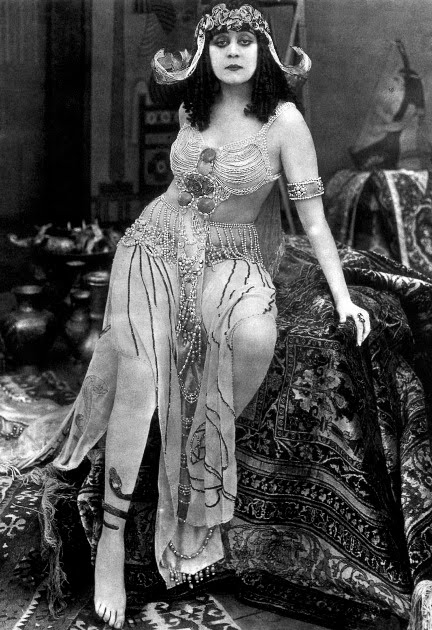
Photo is actress Theda Bara as Cleopatra
---
And so we leave Map J11 behind as we continue our tour of NODTM. I believe next we will go north to Venatia, a land of thick forests and several competing city-states, including Lyonesse, a city of knights and dames, Antigoon, trading capital of Mother Ocean and Blackpoort, city of smugglers and thieves. Venatia has a more Western European feel, so it should be a nice change from the Mediterranean/N. African vibe of the Wyvern Coast and Nabu.
Before I hit Venatia, though, I have a druid class and spell list to write ...