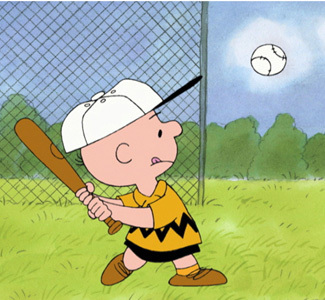
You never know what will inspire an idea, and this one came from watching an episode of Father Knows Best before driving to work. In this particular episode, good old dad tells Bud to use his charm when trying to apologize/ask out a girl. Now, Bud was already in the position of apologizing to the girl because of his so-called "charm", so the interchange got me thinking about the value of putting extra effort behind a task.
In games, we often have characters making skill or ability checks of some kind, assuming they are putting forth their best effort to accomplish the task at hand. Maybe they are ... but I suppose we've all been in the situation of "coasting" by on things we're good at, or even of not trying all that hard to do something we know we're bad at. There are times, though, when something must be done, and so we focus just a bit harder on success. In terms of Charles Schultz's Peanuts strips, it looks something like this:
That tongue sticking out means Charlie Brown is digging deep and putting all his effort into it. So, how do you do this in a game?
The simplest way is to give the players a once a session or even "once per day" chance to really focus on a task or saving throw or maybe even an attack. For attacks and saving throws, you might give a +1 bonus, while for skill and ability checks, a +2 or +10% bonus. You could also just allow a single re-roll on a failed try at something.
So - what does this extra effort cost?
Maybe nothing. I've heard some supposed experts speak on the subject of will power, forwarding the idea that we all have it, but in limited supply. This "extra effort" bonus could just be a free gift to the players.
You could also make it a trade off. Maybe putting forth extra effort involves becoming fatigued for a period of time - say an hour. You could even split mental fatigue from physical fatigue.
If the group is touchy-feely, perhaps the player has to share an episode in his or her past in which they had to dig deep to do something, or in which they goofed off and really screwed up.
If you want to get really nasty, make players spend a few XP for that extra effort - not a huge amount of XP, of course, but maybe 10 or 25.
Oh - and make the player stick their tongue out of the side of their mouth while they're rolling the dice. That I insist upon!
Showing posts with label rules. Show all posts
Friday, February 3, 2017
Dig Deep
Labels:
Legacy DnD,
Notions,
RPG,
RPG Hub,
rules
Friday, June 10, 2016
Courtly Love for Paladins
Here's another notion I came up with for Blood & Treasure Second Edition that I decided not to use in the rules, as it seemed to be just one more thing to stack on top of paladins. Although the ability is designed for paladins, it could be extended to any Lawful Good character if a referee wished. It is probably most useful in a chivalric campaign.
The ability is, of course, inspired by Lancelot and Guinevere.
Courtly Love
Before reaching 5th level, a paladin may select a charming man or woman as their object of courtly love. The chosen must have a Charisma score of 13 or higher, and must be a member of the aristocracy, nobility or royalty. They may be married, and must not be Chaotic. The paladin holds them up as an ideal and does heroic deeds in their name and for their favor. The paladin may not deny them requests, so long as they do not violate his alignment and code of conduct, though in disobeying the object of courtly love becomes displeased, and the paladin suffers a -1 penalty to attack and to all saving throws until they are again pleased. The paladin remains true to their courtly love forever - they may not "break up" with them without losing their paladin status.
When the paladin performs a heroic deed for their courtly love, there is a chance in 20 equal to the paladin’s level that their love is pleased and grants them a token (a scarf, a pin, a lock of hair, etc.) While in possession of this love token, the paladin may invoke the the following effects three times: Add his love's Charisma bonus to an attack roll, a damage roll or a saving throw.
When so pleased by their paladin, there is a percentage chance equal to the paladin’s Charisma score that the courtly love is overcome by emotion and attempts to seduce the paladin into a true romance. The paladin may not give in to this temptation without breaking his code and losing his paladin status. That being said, to refuse makes the courtly love displeased (see above). A Lawful love will not press the matter, but may suffer as per a geas if their love is not returned. A Neutral love will press the matter, forcing the paladin to pass a saving throw to resist the temptation. The TK may add the paladin's Wisdom bonus to the saving throw, but must subtract his love's Charisma bonus from the roll as well.
The ability is, of course, inspired by Lancelot and Guinevere.
Courtly Love
Before reaching 5th level, a paladin may select a charming man or woman as their object of courtly love. The chosen must have a Charisma score of 13 or higher, and must be a member of the aristocracy, nobility or royalty. They may be married, and must not be Chaotic. The paladin holds them up as an ideal and does heroic deeds in their name and for their favor. The paladin may not deny them requests, so long as they do not violate his alignment and code of conduct, though in disobeying the object of courtly love becomes displeased, and the paladin suffers a -1 penalty to attack and to all saving throws until they are again pleased. The paladin remains true to their courtly love forever - they may not "break up" with them without losing their paladin status.
When the paladin performs a heroic deed for their courtly love, there is a chance in 20 equal to the paladin’s level that their love is pleased and grants them a token (a scarf, a pin, a lock of hair, etc.) While in possession of this love token, the paladin may invoke the the following effects three times: Add his love's Charisma bonus to an attack roll, a damage roll or a saving throw.
When so pleased by their paladin, there is a percentage chance equal to the paladin’s Charisma score that the courtly love is overcome by emotion and attempts to seduce the paladin into a true romance. The paladin may not give in to this temptation without breaking his code and losing his paladin status. That being said, to refuse makes the courtly love displeased (see above). A Lawful love will not press the matter, but may suffer as per a geas if their love is not returned. A Neutral love will press the matter, forcing the paladin to pass a saving throw to resist the temptation. The TK may add the paladin's Wisdom bonus to the saving throw, but must subtract his love's Charisma bonus from the roll as well.
![]() |
| Uh oh - he better not try to turn undead any time soon ... |
Labels:
blood and treasure,
Legacy DnD,
Notions,
RPG,
RPG Hub,
rules
Wednesday, June 8, 2016
Don't Lose Your Barbaric Edge
This is a half-formed notion that came to me last night while working on Blood & Treasure Second Edition. It's not in that book, but I thought somebody might find it useful.
The idea of a "barbaric edge" comes from good old Robert E. Howard, who posited the notion that barbarians were in many ways superior to members of civilization, whether they be decadent nobles or downtrodden peasants. Barbarians in Howard's fiction are usually a cut above non-barbarians.
The Edge
In games, the barbaric edge allows you to treat one of the following ability scores - Strength, Dexterity, Constitution or Wisdom - as though it were an 18. Each morning, a person with the barbaric edge can decide which ability they will treat this way. Ability damage affects the temporary score, and the real score if the damage persists and the barbarian chooses to boost a different ability score from the one that was damaged.
Note that druids who boost Wisdom do gain extra spells for high Wisdom, but clerics do not unless they worship something wild and primordial. One might permit it for a cleric of Thor, for example, but not a cleric of Minerva.
Example: Crom the Barbarian (pictured above) wakes up one morning and stretches his iron sinews. He normally has a strength score of 13 (a +1 bonus). Today, he'll increase his bonus (but not his actual strength score) to +2. Tomorrow he might be feeling especially cat-like, and improve his +0 dexterity modifier to +1.
Gaining the Edge
How does one obtain a barbaric edge? By living rough in the wilderness and eschewing the soft pleasures of civilization. This means that the barbaric edge is open to any class, provided they do the following:
1) Always sleep outside in the wilderness; in a pinch, sleeping in an alley or field will do. This means no beds, no pillows - no more than an animal pelt to protect you from the elements.
2) Low retention of wealth; you can keep 10% of your found treasure to spend on equipment and gear (maybe more if you use a system that requires paying for training to level up), giving the rest away. Treasure is there to be won, not enjoyed - think of it as catch-and-release. Treasure not kept must either be discarded as though it were trash, given to others (who may not spend it on you) with a hearty sniff of contempt, or spent in a tavern on booze and sex (i.e. drinks on the house, and you must drink until you collapse or get in a rip-roaring fight).
3) No fancy clothes or armor; you retain the barbarian edge by wearing no more than leather armor or maybe a chainmail shirt if they are used in the campaign. You cannot wear silks and satin - really just a loincloth and sandals or fur boots will do when you're not fighting.
4) A lack of trust for civilization and civilized people. A barbarian can adventure with civilized men and women, but they must be kept at an emotional distance, and the barbarian must sneer at and criticize their soft living and decadent morality. This is primarily done through role playing.
5) A barbarian's food must come from his own hunting, gathering or fishing rather than from "iron rations" and magic. If this means going hungry, so be it. The barbarian may indulge in a tavern after an adventure, but only once and only in terms of a tavern crawl as in (2) above.
Losing the Edge
Breaking any of these rules means the barbaric edge is lost. No ability boosts. It can only be regained by living by the above rules for a full month of game time (or perhaps for two or three game sessions if that's easier to calculate). Only after that time spent living wild does the barbarian shake off the excesses of civilization and regain his barbaric edge.
The idea of a "barbaric edge" comes from good old Robert E. Howard, who posited the notion that barbarians were in many ways superior to members of civilization, whether they be decadent nobles or downtrodden peasants. Barbarians in Howard's fiction are usually a cut above non-barbarians.
The Edge
In games, the barbaric edge allows you to treat one of the following ability scores - Strength, Dexterity, Constitution or Wisdom - as though it were an 18. Each morning, a person with the barbaric edge can decide which ability they will treat this way. Ability damage affects the temporary score, and the real score if the damage persists and the barbarian chooses to boost a different ability score from the one that was damaged.
Note that druids who boost Wisdom do gain extra spells for high Wisdom, but clerics do not unless they worship something wild and primordial. One might permit it for a cleric of Thor, for example, but not a cleric of Minerva.
Example: Crom the Barbarian (pictured above) wakes up one morning and stretches his iron sinews. He normally has a strength score of 13 (a +1 bonus). Today, he'll increase his bonus (but not his actual strength score) to +2. Tomorrow he might be feeling especially cat-like, and improve his +0 dexterity modifier to +1.
Gaining the Edge
How does one obtain a barbaric edge? By living rough in the wilderness and eschewing the soft pleasures of civilization. This means that the barbaric edge is open to any class, provided they do the following:
1) Always sleep outside in the wilderness; in a pinch, sleeping in an alley or field will do. This means no beds, no pillows - no more than an animal pelt to protect you from the elements.
2) Low retention of wealth; you can keep 10% of your found treasure to spend on equipment and gear (maybe more if you use a system that requires paying for training to level up), giving the rest away. Treasure is there to be won, not enjoyed - think of it as catch-and-release. Treasure not kept must either be discarded as though it were trash, given to others (who may not spend it on you) with a hearty sniff of contempt, or spent in a tavern on booze and sex (i.e. drinks on the house, and you must drink until you collapse or get in a rip-roaring fight).
3) No fancy clothes or armor; you retain the barbarian edge by wearing no more than leather armor or maybe a chainmail shirt if they are used in the campaign. You cannot wear silks and satin - really just a loincloth and sandals or fur boots will do when you're not fighting.
4) A lack of trust for civilization and civilized people. A barbarian can adventure with civilized men and women, but they must be kept at an emotional distance, and the barbarian must sneer at and criticize their soft living and decadent morality. This is primarily done through role playing.
5) A barbarian's food must come from his own hunting, gathering or fishing rather than from "iron rations" and magic. If this means going hungry, so be it. The barbarian may indulge in a tavern after an adventure, but only once and only in terms of a tavern crawl as in (2) above.
Losing the Edge
Breaking any of these rules means the barbaric edge is lost. No ability boosts. It can only be regained by living by the above rules for a full month of game time (or perhaps for two or three game sessions if that's easier to calculate). Only after that time spent living wild does the barbarian shake off the excesses of civilization and regain his barbaric edge.
![]() |
| Don't trust them Conan, they use rugs! |
Labels:
blood and treasure,
bloody basic,
Legacy DnD,
Notions,
RPG,
RPG Hub,
rules
Thursday, May 19, 2016
The Wages of Fame
| William Tell |
Here's an idea for handling fame without adding too much in the way of rules or complications. It might suck, but here it is anyways.
Accumulating Fame
How do people become famous in a medieval milieu? For the purposes of D&D and similar games, it makes sense to tie fame to deeds. Hey, if Bob jumps over a cow at the local faire, people in the village will know that Bob is famous for jumping. They'll tell others, and maybe for several villages around Bob will be known as "the jumper". So it goes with adventurers.
Since fame is tied to deeds, it also makes sense that fame is tied to XP. XP are handed out for deeds, therefore XP equals fame.
Or does it?
In our example above, everyone saw Bob jump over the cow. If Bob had done it without witnesses, and just claimed to have jumped over a cow, he might have become known as Bob the Liar rather than Bob the Jumper. So, in this system, XP only turn into fame when the deeds that generated the XP are either witnessed by the public at large, or can be proved. If you want to use this system, you'll need to put a second XP number in parentheses after the normal XP number.
You accumulate these "fame XP" by doing things in front of people, or you need to spend or display the treasure you looted, and you need to bring back trophies (at least one really good one, the gorier the better) to show that you defeated monsters or black knights or wizards. If you do these things, you count those XP towards your fame level.
Since we have a separate "fame XP", we also have a separate "fame level". For simplicity's sake, use the Fighter's XP progression in your game as the Fame XP progression. Fame levels are as follows:
The Upside of Fame
So, what do these fame levels get you?
First level fame is worth nothing.
From 2nd level onward, they enjoy the following benefits:
1) They have a percent chance of drinking for free and picking up interesting rumors in taverns
2) They have a percent chance of getting an invite to dine with notables equal to their fame level, the chance depending on the size of the settlement
3) You can employ an extra number of henchmen equal to your fame level, and their base loyalty is increased by a number of percentage points equal to your fame level
4) You can request audiences with princes, kings, emperors, high priests, etc. You have half this chance of requesting a boon in exchange for a favor, and a percent chance equal to your fame level of requesting a boon in exchange for nothing
The Downside of Fame
Fame has a downside as well. When you enter an area, your fame might proceed you. You can cut the chances of being recognized by wearing a disguise and using a different name, but lose the benefits of fame (see above) if you do so. Here's a twist - if you are moving in a group and not everyone in the group is disguised, your chances of being noticed are increased by 5% per undisguised person.
If you are recognized, one of the following happens:
Challenges: You will be challenged to a duel (magical or martial) or test of skill by other notables in the area. This will be public. Losing these challenges actually reduces your fame XP level by as much as it would have increased if you had won.
Quests: If you are neutral or lawful (good), and there's trouble afoot, you will be asked to handle it. If people have been kidnapped or there are monster's raiding the area, you are expected to solve it. If you refuse, you lose enough XP to take you down a fame level. You suffer the same consequences if you fail at the quest.
Justice: If you are chaotic (evil), you are set upon by the authorities in the area, or bounty hunters or people you wronged in the past. In other words, being famous and evil means being hunted.
For this reason, characters might discover that fame is a double-edged sword.
Death
Nobody wants to die, but dying famous is probably better than dying unknown for an adventurer. When a character dies, the following happens:
6% chance per fame level of a folk song being composed in their honor
4% chance per fame level of a biography being written about them
2% chance per fame level of a monument being erected where they died or a civilized place nearby
For clerics, druids and paladins, there is a 1% chance of them being canonized
Now, total these honors received. This is the percent chance (thus, maximum 4%) that upon death they are received by "the gods" into their company as a quasi-deity. They can still be used as PC's, with powers deemed suitable by the DM, but only in the company of other quasi-deities or demi-deities and the like. Congratulations!
Labels:
Legacy DnD,
Notions,
RPG,
RPG Hub,
rules
Thursday, February 25, 2016
Easy Peasy Wracked with Diseasy
![]() |
| Illustration by Jon Kaufman |
That brings me to disease. The rules I used before were relatively easy, but I wasn't really satisfied with them. I hit on this point in a post a while back, and developed a disease system that I published in NOD 28 that focuses on symptoms rather than on named diseases. For Blood & Treasure, I decided to use a simplified version of this. While somewhat random, it takes into account the monster or dungeon level delivering the disease, and hopefully sets up a race against time aspect that will add to rather than diminish the drama of an adventure.
DISEASE
When a character is injured by a contaminated attack, touches an item smeared with diseased matter or consumes disease-tainted food or drink, he must make an immediate Fortitude save. If he succeeds, his immune system fights off the disease and he suffers no ill effect.
If he fails the saving throw, the TK rolls 1d6 and adds the Hit Dice of the monster that infected him, or the level of the dungeon on which he was infected. Consult the table below. The infected creature will suffer all of the effects on the table up to the number rolled. The effects start at the times indicated on the table.
For example, a character who is both fatigued and sickened with feel the effects of fatigue in one round, and the effects of being sickened in 1 turn.
If an ability score is indicated, roll 1d10 to determine which score is affected:
Each day, the creature can attempt a new Fortitude save against the disease. If the roll is a failure, he continues suffering the ill effects as indicated on the table. If he succeeds, those ill effects are reduced by one level. When the character suffers no further ill effects, the disease has run its course.
While the character is diseased, they do not benefit from natural healing, although magical healing works on them. A cure disease spell will, of course, completely eradicate the disease, ending all ill effects.
Of course, once "cure disease" shows up, it just doesn't matter, which is why the system is short.
I MIGHT CHANGE SAVING THROWS
This brings up the other part of the game I might streamline. I say might, because I haven't made the change yet.
Saving throws in the game currently use three categories - Fortitude, Reflex and Will. As categories, they make sense and players can generally figure out what save they should be making when a situation comes up.
A post over at Delta's D&D Hotspot got me thinking of another way that is more "gamist", but which I think might be an improvement.
Delta was showing how the OD&D fighter's saving throws went in an order from easiest to hardest, with the easiest saves being the one's against the most dire circumstances. I like this idea. Why should it be easiest to save vs. petrification? Because failing that save means your character is dead, unless you have a high enough level magic-user who can turn you back. It treats saving throws more as "get out of jail free" cards than as simulating something real. I know this will bug the heck out of some folks, but I like it. It keeps the game a game.
This got me thinking about using a single saving throw number for each level - so only one number on the sheet, which fits into streamlining - with a blanket +3 bonus against instant effects that are (almost) unalterable - things that really screw up your precious character like instant death, polymorph, paralysis, petrification and the like. The classes would then have their own little +1 to save vs. something - fighters vs. dragon breath, spellcasters vs. spells - that sort of thing.
If I'm honest ... it also saves lots of room in the books and makes monsters a bit easier to run.
Again, I haven't made this change yet, but I think I'm going to.
I'm like 90% certain I'm going to.
Probably.
I think.
Labels:
blood and treasure,
Legacy DnD,
RPG,
RPG Hub,
rules
Thursday, February 11, 2016
Blood & Treasure 2nd Edition - Skills
![]() |
| Part of cover illustration by David Williams |
Blood & Treasure was designed to be rules lite and options heavy, and that isn't changing in the new edition. My goal is to take nothing out of the game, but to, wherever possible, correct old mistakes and streamline old rules to make them easier to understand and play. That brings us to subject #1 - Skills.
Or tasks, as I prefer to call them. I thought the old system was pretty easy - to whit - if a character is unskilled at a task, roll 1d20, beat 18 and succeed. If a character has a knack (such as an elf searching for secret doors), roll 1d20, beat 15 and succeed. If a character is skilled, roll a saving throw to avoid failure at the task. That way, the skilled - such as thieves climbing walls - get better at tasks as they advance.
Apparently, though, it caused some confusion for people, specifically the saving throw idea. So, how do we adjust?
As follows:
To perform tasks outside of combat, one need only tell the Treasure Keeper (TK) what they wish to accomplish. If the TK thinks the task can be accomplished without much difficulty, he merely tells the player they were successful.
If success is in doubt, either because of the degree of difficulty of the task, or conditions that would make success unlikely, the TK can require a task check.
To make a task check, the player rolls 1d20 and adds to this roll the relevant ability score modifier (see table below) and any bonuses they might have for their race, class or other circumstances.
If the roll is 18 or higher, the task check is a success. If the roll is lower than 18, it fails, with the consequences of the failure determined by the Treasure Keeper.
If the task is one in which a character class is “skilled”, they add their level to the task check.
The ability scores associated with various tasks are as follows (though note that the Treasure Keeper may rule that under some conditions a task might be modified by a different ability score.) ...
What follow that is a list of possible tasks, and the ability score that modifies them, such as acrobatics modified by dexterity or swimming modified by strength.
Several tasks rely on using tools. Trying to perform these tasks without the proper equipment should be done at a -2 penalty.
The key thing to remember about tasks checks is that if it seems reasonable that a character can do it, there is no need to roll dice! Save the rolling of dice for difficult, dangerous or dramatic tasks.
Here's where the options kick in. For those who like the 3rd edition approach, I have an optional simplified skill points system:
Skill Points (Optional)
If your players would like more control over their character’s skills – and you want them to have that control – you can allow them to spend “skill points” on the various tasks in this chapter, each point spent giving them a +1 bonus to use those skills in play.
When attempting a task, the player rolls 1d20, adds their skill bonus, ability modifier, bonuses for race or circumstances, and attempts to roll an 18 or higher to succeed.
The number of skill points available to a character to spend at each level depends on the character's class. Multi-class characters add their class' skill point totals together.
For those who instead prefer the way old editions handled such things, I have a system inspired partially by the rules for finding secret doors and partially on the original (pre-Gygax) thief class that has been making the rounds in the OD&D blogosphere of late.
Simple Task Checks (Optional)
If you would like to keep task checks extremely simple, you may use the following system:
If characters attempt something at which they are untrained, roll 1d6. On a roll of 1, they succeed.
If they are attempting something at which they excel due to their race, such as elves finding secret doors, roll 1d6. On a roll of 1 to 2, they succeed.
If they are attempting something at which they are skilled due to their character class, consult the following table:
If the task is more difficult than usual, the TK can rule that it must be rolled on a larger dice, usually d8 or d10.
Note that this system does not take into account ability scores, which may disappoint some players.
So, three options on handling skills in Blood & Treasure taking up about a page and quarter in the rule book. As a game master, I would probably let the players use the standard system, and would use the simplified system for monsters and NPCs.
As always, I'd like to hear the opinions of the readership, especially those who are interested in Blood & Treasure.
Next time, I'll discuss what I might do with saving throws in 2nd edition Blood & Treasure
Labels:
blood and treasure,
Legacy DnD,
previews,
RPG,
RPG Hub,
rules
Thursday, January 21, 2016
Weapons Increase Armor Class?
I had a little notion this morning about a different way to run combat in d20-esque games. This is a departure from normal combat, but can be done pretty easily.
Here's the plan:
Damage is not based on the weapon, but on the success at the attack roll. There are a variety of ways you can do this. The most simple would be something like:
Roll < AC = no damage (obviously)
Roll = AC = 1d3 damage ('tis but a scratch)
Roll = AC +1 = 1d4 damage
Roll = AC +2 to +3 = 1d6 damage
Roll = AC +4 to +5 = 1d8 damage
Roll = AC +6 to +7 = 1d10 damage
Roll = AC +8 to +9 = 2d6 damage
And so on, adding +1d6 to damage each time. You can adjust the ranges and damages to suit yourself, of course.
So what good is a weapon in this system?
Weapons in this system would add to AC based on their length. If your weapon is longer than your opponent's weapon, it is harder for the opponent to get close and strike. We could say for every foot difference in the length of the weapons, you get a +1 to AC, up to a max. of +3. We don't want the weapon's length to completely overshadow actual armor in the AC calculation. We might also want to factor in the size of the combatants, with maybe every 2' of height (or length) equaling a +1 bump to AC, up to +3. The combination of height and weapon length, therefore, would give a max. bump to AC of +6.
Weapons also add to damage based on their stated damage in the rule books, as follows:
1 to 1d3 damage = +0 to damage
1d4 damage = +1 to damage
1d4+1 and 1d6 damage = +2 to damage
1d6+1, 1d8 and 2d4 damage = +3 to damage
1d10 damage = +4 to damage
1d12 and 2d6 damage = +5 to damage
Strength also adds to damage, as normal, and dexterity adds to AC.
Example Combat: Halfling Fighter vs. Ogre
We'll pit two combatants against one another.
The first is a 5th level halfling fighter with a +1 Dex bonus and platemail and a short sword. The halfling (using Blood & Treasure rules) has a total bonus to hit of +5 (for level, no strength bonus). Her armor class is 18 (+7 armor, +1 Dex). She has 28 hit points.
The second is a 4 HD ogre with no armor and a spear. The ogre has a +4 bonus to hit (based on his HD) and AC 16. He has 17 hit points.
We'll impose the following adjustments, based on the above rules:
The ogre is 8 feet tall, vs. the halfling's 3 feet of height. This is a 4' difference, so the ogre gets a +2 bonus to AC. The ogre is also using a 6-foot long spear, vs. the halfling's 3-foot long short sword, which gives the ogre another +3 bonus to AC. This gives the ogre a total AC of 21 in this fight.
The halfling's short sword gives her a +2 bonus to damage. The ogre's spear gives him the same.
We'll give the halfling initiative ... her first attack roll is a 17, +5 for her attack bonus, equals 22. This beats the ogre's AC by 1 point, and thus scores 1d4+2 damage. In this case, 4 points of damage. This reduces the ogre to 13 hit points.
The ogre rolls a 19+4 = 23. This beats the halfling's AC by 5, which translates into 1d8+2 damage. The ogre rolls 5 points of damage, reducing the halfling to 23 hit points.
In the next round, the halfling rolls a 23, beating the ogre's AC by 2, and scoring 1d6+2 damage. The halfling rolls another 4 points of damage, reducing the ogre to 9 hit points.
The ogre responds with an attack roll of 5, missing the halfling.
And so on ... it is likely that the halfling will win the fight, though the ogre has a slightly better chance to score more damage, and he is slightly harder to hit.
Final Thoughts
I don't think this is a better way to run combat, just different. If it has any advantage, it is that it takes into account the reach of a creature and weapon in a way that normal combat rules do not. Further development of the idea might lead to a better system, or might suggest alterations to the existing combat system that might make it better.
Here's the plan:
Damage is not based on the weapon, but on the success at the attack roll. There are a variety of ways you can do this. The most simple would be something like:
Roll < AC = no damage (obviously)
Roll = AC = 1d3 damage ('tis but a scratch)
Roll = AC +1 = 1d4 damage
Roll = AC +2 to +3 = 1d6 damage
Roll = AC +4 to +5 = 1d8 damage
Roll = AC +6 to +7 = 1d10 damage
Roll = AC +8 to +9 = 2d6 damage
And so on, adding +1d6 to damage each time. You can adjust the ranges and damages to suit yourself, of course.
So what good is a weapon in this system?
Weapons in this system would add to AC based on their length. If your weapon is longer than your opponent's weapon, it is harder for the opponent to get close and strike. We could say for every foot difference in the length of the weapons, you get a +1 to AC, up to a max. of +3. We don't want the weapon's length to completely overshadow actual armor in the AC calculation. We might also want to factor in the size of the combatants, with maybe every 2' of height (or length) equaling a +1 bump to AC, up to +3. The combination of height and weapon length, therefore, would give a max. bump to AC of +6.
Weapons also add to damage based on their stated damage in the rule books, as follows:
1 to 1d3 damage = +0 to damage
1d4 damage = +1 to damage
1d4+1 and 1d6 damage = +2 to damage
1d6+1, 1d8 and 2d4 damage = +3 to damage
1d10 damage = +4 to damage
1d12 and 2d6 damage = +5 to damage
Strength also adds to damage, as normal, and dexterity adds to AC.
Example Combat: Halfling Fighter vs. Ogre
We'll pit two combatants against one another.
The first is a 5th level halfling fighter with a +1 Dex bonus and platemail and a short sword. The halfling (using Blood & Treasure rules) has a total bonus to hit of +5 (for level, no strength bonus). Her armor class is 18 (+7 armor, +1 Dex). She has 28 hit points.
The second is a 4 HD ogre with no armor and a spear. The ogre has a +4 bonus to hit (based on his HD) and AC 16. He has 17 hit points.
We'll impose the following adjustments, based on the above rules:
The ogre is 8 feet tall, vs. the halfling's 3 feet of height. This is a 4' difference, so the ogre gets a +2 bonus to AC. The ogre is also using a 6-foot long spear, vs. the halfling's 3-foot long short sword, which gives the ogre another +3 bonus to AC. This gives the ogre a total AC of 21 in this fight.
The halfling's short sword gives her a +2 bonus to damage. The ogre's spear gives him the same.
We'll give the halfling initiative ... her first attack roll is a 17, +5 for her attack bonus, equals 22. This beats the ogre's AC by 1 point, and thus scores 1d4+2 damage. In this case, 4 points of damage. This reduces the ogre to 13 hit points.
The ogre rolls a 19+4 = 23. This beats the halfling's AC by 5, which translates into 1d8+2 damage. The ogre rolls 5 points of damage, reducing the halfling to 23 hit points.
In the next round, the halfling rolls a 23, beating the ogre's AC by 2, and scoring 1d6+2 damage. The halfling rolls another 4 points of damage, reducing the ogre to 9 hit points.
The ogre responds with an attack roll of 5, missing the halfling.
And so on ... it is likely that the halfling will win the fight, though the ogre has a slightly better chance to score more damage, and he is slightly harder to hit.
Final Thoughts
I don't think this is a better way to run combat, just different. If it has any advantage, it is that it takes into account the reach of a creature and weapon in a way that normal combat rules do not. Further development of the idea might lead to a better system, or might suggest alterations to the existing combat system that might make it better.
Labels:
blood and treasure,
Legacy DnD,
Notions,
RPG,
RPG Hub,
rules
Monday, November 24, 2014
Undead, Yes ... But What Else Can We Turn?
![]() |
| Now imagine the cross is a pole, and she's a chasm. Image found HERE. |
At its heart, an RPG (or really any game) is just a collection of mechanics hiding underneath a layer of fluff. In an old school world, simplicity and, to some degree, minimalism is important - that means getting as much mileage as possible from the rules you have, so that you can avoid creating new rules. One rule mechanic that doesn’t get used enough, I think, is the Turn Undead table.Well ... let me rephrase that. It gets used all the time when people are turning undead, but the rule concept itself could probably be used to do more than just turn undead.
What follows are a few ideas for how you can tweak the Turn Undead table.
1. Alternate Targets
I've used the basic concept of "turning" in my games and unhinged it from the undead. The beastmaster class I wrote, for example, can turn animals. I meant it as a means of representing Tarzan's ability to cow animals and send them packing without having to necessarily fight them. In Grit & Vigor, I played with the idea of letting the dreadnought (a sort of big, scary guy archetype ... think Mr. T) use a table like that to frighten low-level NPCs, or at least stun them into inaction. I'm picturing Mr. T walking into a room and glaring at the thugs while he and the A-Team walk through unscathed, nobody daring to mess with them.
What else can you turn?
Different alignments - perhaps a wretched villainous NPC can force good creatures away through a sort of self-righteous repulsion. Maybe a chaotic troublemaker has the ability to turn authorities, though in this case it would represent the troublemaker avoiding their notice rather than frightening them away.
Different creatures - if the beastmaster can turn animals, maybe a dragon slayer can attempt to turn dragons (probably only succeeding on the little ones). What about turning reptiles, or turning elementals, or turning specific creature types as a lesser special ability?
2. Alternate Effects
I already hit on this above, in the chaotic troublemaker using "turn undead" to avoid the notice of lawful creatures. You could also replace turn/destroy (and rebuke/command) with ...
Annoy/enrage (a jester class might use this)
Charm/control (or dominate, great for a succubus class)
Stun/confuse (a riddlemaster? Kirk dealing with computers?)
Capture/kill
Maybe a swashbuckler can "turn blades" as a way to represent a lone swordsman confronted with a multitude of minor combatants. One swipe of his blade, and a random number of lesser swordsmen are "parried/disarmed".
I'm sure there are many other possible variations. Just think in terms of partial success/complete success, pick a class of targets, and you're done.
3. Alternate Function
The Elementalist class I wrote used a variation on the turn undead chart to cast spells. For the elementalist, the idea was that the magician was controlling elemental spirits and forcing them to create the magic effects on his behalf, so a turn undead table made sense.
You could further twist the Turn Undead table concept to entertain crowds, convert heathens or solve conundrums. How about turning spells, using the Turn Undead mechanic as a counterspell mechanic.
In fact, the Turn Undead table could probably serve as a general task resolution mechanic - rate the difficulty of a task from 1 to 10 (or skeleton to vampire - "Gee Bob, that chasm's a real vampire - are you sure you want to try to jump it?) and roll the dice.
Just a few ideas for getting the most out of your chosen ruleset.
Labels:
Legacy DnD,
Notions,
RPG,
RPG Hub,
rules
Friday, October 3, 2014
What's It Worth?
![]() |
| I'll give you 10 gp, and not a copper more |
Currently, when I'm writing a hex crawl, I'll include treasure hordes with notations like "large ruby worth 5,000 gp". What if, instead, I merely wrote "large ruby" and let the value be determined by the customer?
The basic idea: Come up with a matrix. The columns represent different classes of customers, the rows different categories of treasure. The data would be a random amount of money that the customer would be willing to pay for the treasure. The GM would roll this to determine the starting bid, and then roll a second dice to determine how high the customer will go. Adventurer and customer (GM) could then work out a final price for the item by haggling.
Classes of Customer
Peasants: These are your average working stiffs - laborers in towns and cities, people who carry things and serve others. They didn't make much money in the real world - some would figure it at the equivalent of 1 or 2 copper pieces a day - but in the fantasy world, the standard is 1 silver piece per day. Either way, they have expenses, so they can't afford to spend much on luxuries like treasure. There is a 90% chance they'll offer goods and/or services instead of coins.
Artisans & Traders: These skilled laborers make a bit more, maybe five times as much as the peasants. This gives them a bit more money for luxuries. Still, if adventurers are going to these guys to sell their treasure, they're probably a bit hard up. There is a 75% chance they'll offer goods and/or services instead of coins.
Merchants: The merchants have plenty of money, though their assets probably aren't liquid (meaning they have lots of stuff - goods, wagons, camels, ships - but not lots of money). Still, they aren't hurting, and they can drop a few coins on the good things in life. There is a 50% chance they'll offer goods and/or services instead of coins.
Merchant Princes: These are the big-time merchants, the fellows with royal and noble connections that allow them to own fleets and caravans and manors, etc. They're going to be a bit more liquid than the common merchants. There is a 35% chance they'll offer goods and/or services instead of coins.
Aristocracy: The lower end of the titled fellows - the knights and baronets and such. Like the merchants, their wealth is mostly tied up in things - land, animals, armor, weapons - so they're like uber-barterers. They have a few coins stashed away, but they're probably more apt to trade things like armor, horses or favors. There is a 65% chance they'll offer goods and/or services instead of coins.
Nobility: The nobility includes barons, counts, and the like. Lots of land, but, as with the merchant princes, more liquid than the aristocracy. There is a 25% chance they'll offer goods and/or services instead of coins.
Lesser Royalty: A step up from the nobility - the dukes and bishops. There is a 20% chance they'll offer goods and/or services instead of coins.
Greater Royalty: Kings, queens, princes and princesses, and archbishops as well. There is a 12% chance they'll offer goods and/or services instead of coins.
Imperials: Not Chryslers, but actual imperials - emperors, empresses, kings-of-kings, popes, etc. There is a 6% chance they'll offer goods and/or services instead of coins.
Categories of Treasure
These are the same categories you will find in Blood & Treasure, and adapting them to your favorite game shouldn't be too taxing on the grey matter.
Fancy Stones - agates, hematite - the stuff you find in shopping malls and tourist traps
Gems - better than stones, not as good as jewels
Jewels - rubies, emeralds, sapphires, diamonds
Common Arts & Trade Goods - armor, weapons, things made out of non-precious metals, common animal skins, rugs, many tapestries, common sorts of books. Assume the price is per ounce where applicable.
Fine Arts & Exotic Goods - lacquered wood, rare spices, items made from precious metals, bejeweled items, the skins of exotic animals, rare books, especially fine paintings and tapestries. Assume the price is per ounce where applicable.
Minor Magic Items - potions, scrolls, magical oddities
Major Magic Items - that stuff you really want to put on your character's equipment list
The Table
The table above is a simple matrix. Find the category of treasure and the category of customer, and you get their opening bid. Roll a d6 to find out how high they'll actually go:
1-3: No more than 25% higher, and they might have some conditions
4-5: No more than 50% higher
6: No more than 100% higher
Also, remember that there is a percentage chance that the customer offers to pay with goods and/or services rather than actual money. The value of services rendered is up to you, but most games give some sort of guidance. Favors are tricky - they may not be honored at a later date - but they could come in handy.
Obviously, some interpretation is involved here for the GM in terms of treasure category and customer category, and feel free to apply other factors. In a country where gold or silver is common, objects made from gold and silver might be considered common arts rather than fine arts. Likewise, spices, furs and pelts might be common one place and exotic in another.
The impetus for this table was a painting I posted a few weeks ago when I asked the question "Are Treasure Hordes Too Small?". The idea here is that you can now provide a fairly large horde without having to predetermine what everything is worth. This system also gives adventurers a reason to make contact with nobles and such, which in turn can lead to further adventures.
Labels:
Legacy DnD,
RPG,
RPG Hub,
rules,
treasure
Thursday, January 23, 2014
The Evils of Drink and Other Intoxicants [GRIT AND VIGOR]
![]() |
| From Wikipedia |
Why I never thought of writing these rules for Blood & Treasure, I don't know, but they would work for that game and most other old school games I should suppose. Obviously, the rules are kept simple and abstract - they're meant to take up a column of the rulebook, not a chapter - but I think they'll do the job.
--
INTOXICANTS
Strong men often crave strong drink to dull the pain of living, or to celebrate a hard-fought victory. Of course, alcohol isn’t the only intoxicant a man or his enemies might use. Intoxicants are treated as poisons, and thus require a Fortitude saving throw to resist. They come in three broad varieties: Depressants, stimulants and hallucinogenics.
Intoxicants are also given two levels of efficacy – mild and strong. A strong substance not only has a greater effect than a mild one, and it imposes a -10 penalty to save against it.
The dosage of intoxicants varies widely, so use your best judgment. Mild intoxicants have a duration of 1d6 turns, while strong intoxicants have a duration of 1d6 hours.
If a character already under the effects of a mild intoxicant takes another dose and fails his saving throw, treat him as though he has taken a strong intoxicant.
Each time a character falls prey to the effects of a mild intoxicant, there is a 5% chance they will develop an addiction to that intoxicant (rules for that to follow). Strong intoxicants have a 10% chance per use of causing addiction.
MILD DRUG EFFECT
Depressant: -2 penalty to sensory task checks and balance and tumbling task checks, -2 penalty to AC and to all attack rolls, 10% chance per hour of falling asleep
Stimulant: -2 penalty to all wisdom=based task checks and Will saves and saves vs. sleep effects, +2 bonus to all other saving throws and to attack, -2 penalty to AC
Hallucinogenic: Confusion (there would be a page reference here in the rulebook, but if you've played ye old fantasy rpg, you know what confusion does)
STRONG DRUG EFFECT
Depressant: -4 penalty to sensory task checks and balance and tumbling task checks, -4 penalty to AC and to all attack rolls, 10% chance per turn of exhaustion of falling asleep
Stimulant: -4 penalty to all wisdom-based task checks and Will saves and saves vs. sleep effects, +4 bonus to all other saving throws and to attack, -4 penalty to AC, suffers 1d6 points of damage to body per hour of duration, after duration the character is left fatigued for equal duration
Hallucinogenic: Confusion, with a 10% chance that the condition is permanent
Some common intoxicants include the following:
Alcohol: Mild or strong depressantAmphetamine: Strong stimulant
Caffeine: Mild stimulant
Cannabis: Mild depressant and Hallucinogenic
Cocaine: Strong stimulant
Heroine: Strong depressant
LSD: Strong hallucinogenic
Mescaline: Strong hallucinogenic
Morphine: Strong depressant
Mushrooms: Mild or strong hallucinogenic
Nicotine: Mild stimulant
Nitrous: Oxide Mild hallucinogenic
Opium: Strong depressant
Labels:
grit and vigor,
Legacy DnD,
RPG,
RPG Hub,
rules
Tuesday, January 14, 2014
Over In a Nonce - Deadly Dueling
I've done a similar combat system to this one in the past, so consider this a revision or just forget the last one.
Once again, I'm thinking in terms of a deadly combat system, more realistic perhaps than the traditional hit points/armor class system, and potentially over quickly.
The system is written for Blood & Treasure, but should be easy to adapt. It assumes you are using the combat advantage system in Blood & Treasure. It works as follows:
A. Each character makes an attack roll, add half armor class bonus from natural armor or worn or carried armor (i.e. shields) to this roll
B. Compare the attack rolls - high roll wins the combat round
B1. If a combatant rolls a natural '20', their opponent is either killed or, if they are merciful, knocked unconscious or left prone and disarmed (and dishonored)
B2. If a combatant rolls a natural '1', they suffer a catastrophe - roll 1d6
1. Disarmed (must draw another weapon or fight unarmed)
2. Trip or slip (fall prone, Reflex save or lose weapon as well)
3. Backed into corner (opponent gets an advantage, as you cannot maneuver)
4. Face cut (blood in your eyes, opponent gets an advantage)
5. Hand cut (must fight with other hand, giving opponent an advantage unless you are ambidextrous)
6. Roll again (or if anyone has another good idea for a catastrophe, let me know!)
B3. The loser must pass a Fortitude saving throw or is fatigued, suffering the normal penalty to attack rolls, but also extending their fumble range by 1 (i.e. from 1 on 1d20 to 1-2 on 1d20, etc.) A combatant with armor must take a penalty on this save equal to half their armor class bonus.
B4. The winner need only make a Fortitude save vs. fatigue in even rounds of combat. Each round that they win, they increase their critical threat range by 1 (i.e. from 20 on 1d20 to 19-20 on 1d20, etc.)
C. Keep rolling combat rounds until somebody is dead (or unconscious) or surrenders
Multiple Opponents - the outnumbered foe has to roll against each attacker, all of whom derive a combat advantage from the situation, and might have to make multiple saves against fatigue. Only the attacker's first attack roll counts against a chosen opponent in terms of causing fatigue or death. Unlike with normal rules, heroes sallying forth against multiple foes are probably doomed unless they well out-level them.
Multiple Attacks - Monsters or characters with multiple attacks make those attacks as normal, with each defender making their own attack roll against them, or a defender making multiple rolls against them; as above, only the character's first attack roll counts towards causing fatigue or death.
Missile Combat - This system doesn't work for missile weapons, but consider this idea: Make attack rolls against AC as normal. Roll the hit location (you can devise your own table) with that body part being made useless unless the struck character passes a Reflex save. Obviously, hit locations like head, throat or heart would carry with them instant death.
Other Sources of Hit Point Damage: To get rid of hit points, you'd need to deal with things like fire breath or falls. If you like things to be super dangerous, you could always go save or die - or perhaps save vs. being crippled, severely burned (you'd have to determine just what that entails), frostbitten, etc. with a roll of "1" indicating that the attack killed you outright.
Impact of System
A system like this opens some interesting possibilities. High level characters are still hard to kill, but maybe not as hard as before - even a first level character can get lucky against a high level character with a system like this in a way that is essentially impossible using traditional combat. Likewise, first level characters are going to have a tough time surviving, but might actually last many more rounds than they would using the traditional system.
If you try this system out, let me know how it worked.
Labels:
blood and treasure,
Legacy DnD,
Notions,
RPG,
RPG Hub,
rules
Friday, October 11, 2013
Getting Down With the Sickness
I don’t think I’ve ever been 100% satisfied with diseases in role playing games, not even with the rules in Blood & Treasure. This post is an attempt to create a system a bit more granular than most. In this system, diseases are not named, but rather are collections of random symptoms, with the number of symptoms and their severity based on the general severity of the disease.
THE BASICS
When struck with a disease, say from the bite of a rat, a prolonged stay in sewers (or a flophouse) or a biological trap, an adventurer must pass a Fortitude saving throw to avoid suffering any ill effects at all. This might represent a case where the contagion is simply not introduced to the character’s system, or it is introduced and the character’s immune system neutralizes it very quickly.
If this Fortitude save fails, the character is infected. First, we need to know the severity of the disease. The Treasure Keeper can either roll dice to determine severity, or base it on the hit dice of the monster that spread it or the level of the dungeon on which it was acquired.
D% (HD or LEVEL): SEVERITY (SYMPTOMS)
01-75 (0-4 HD): Minor Disease (1d3 minor symptoms)
76-90 (5-9 HD): Medium Disease (1d4 minor symptoms, 1d2-1 major symptoms)
91-100 (10+ HD): Major Disease (1d4 minor symptoms, 1d3 major symptoms)
Symptoms begin appearing within 1d4 days.
The Treasure Keeper should now roll 1d4 minus the sufferer’s Constitution bonus. This is the number of days before the sufferer’s immune system has a chance of defeating the disease. It is possible that the disease can be fought off before any symptoms begin to appear.
Each day, a victim of disease can roll a Fortitude saving throw to attempt to throw off one symptom, usually the most severe, but in any event a symptom of the player’s choice. If the player is successful, that symptom is removed.
If the diseased character is active (i.e. not getting plenty of rest), they suffer a -2 penalty on this save.
All characters that spend time around the diseased character have a percentage chance each day to be exposed to disease. This percentage chance is based on the number of type of symptoms, with a 10% chance per minor symptom and a 5% chance per major symptom. Naturally, the non-diseased character is permitted a Fortitude save to avoid actually contracting the disease.
Note: If you want to give a more supernatural feel to diseases, you can rule that any adventurer who dies from a disease and is not burned or buried in consecrated ground rises as an undead with Hit Dice roughly equal to the number of levels they had in life.
MINOR SYMPTOMS (ROLL 3d6)
3. Exhaustion4. Fever, severe
5. Rash, major
6. Dementia
7. Rash, minor
8. Aches
9. Cough
10. Diarrhea
11. Fatigue
12. Fever, low-grade
13. Sickened
14. Stuffy head/runny nose/sneeze
15. Swollen joints, minor
16. Shooting pains
17. Spasms
18. Swollen joints, major
Aches
The character is possessed of aches in the muscles and joints and suffers a -1 penalty to attacks, Armor Class and Reflex saving throws (including task checks).
Cough
Roll 1d4 for severity; this is the chance on 1d6 per hour that your coughing attracts a wandering monster. After any major exertion (running, fighting, climbing more than 10 feet) you are fatigued until resting 10 minutes.
Dementia
The character is unsteady on his feet. When moving at more than half speed or fighting, he must pass a Reflex save each round to avoid falling prone for 1d4 points of damage. Whenever he is forced to concentrate on spell casting, he must pass a Will save to successfully cast the spell. The character suffers a -1 penalty on all Reflex and Will saves (including task checks).
Diarrhea
Not for the faint of heart. You suffer intestinal distress every 1d6 x 10 minutes and need to find a private place to deal with the problem. If you are not drinking a double ration of water, you suffer 1 point of Constitution damage per day due to dehydration.
Exhaustion
An exhausted character moves at one-quarter normal speed, suffers a -1 penalty to saving throws and task checks and her foes enjoy two tactical advantages against her in combat.
Fatigue
Per the normal rules for this condition in Blood & Treasure.
Fever, Low-grade
The character has a low-grade fever and suffers a -1 penalty to Will saving throws (including task checks). He also requires twice the normal daily ration of water. Failure to hydrate properly results in 1 point of Constitution damage each day.
Fever, Severe
The character has a severe fever and suffers a -3 penalty to Will saving throws (including task checks). He requires twice the normal daily ration of water. Failure to hydrate properly results in 1 point of Constitution damage each day. Finally, the fever causes hallucinations. Each hour, the character must pass a Will save or be struck with the equivalent of the confusion spell for 1d6 x 10 minutes.
Rash, Minor
The character suffers from a minor rash over a small portion of her body and suffers a -1 penalty to attacks, Armor Class and Reflex saving throws (including task checks) due to the discomfort. Each day, the character must pass a Fortitude save to avoid scratching and turning the minor rash into a major rash.
Rash, Major
The character suffers from a major rash over a large portion of her body and suffers a -2 penalty to attacks, Armor Class, Reflex saving throws (including task checks) due to the discomfort and a -2 penalty to Charisma-related task checks due to the physical marring. Each day, the character must pass a Fortitude save to avoid scratching and suffering 1 point of Charisma drain for permanent scarring.
Shooting Pains
The character suffers fierce, shooting pains. She suffers a -2 penalty to attacks, Armor Class and Reflex saving throws (including task checks). Whenever she is forced to concentrate on spell casting, she must pass a Will save to successfully cast the spell. The character suffers a -1 penalty on all Reflex and Will saves (including task checks).
Sickened
Per the normal rules for this condition in Blood & Treasure.
Spasms
The character suffers random severe muscle spasms. This translates as a tactical advantage for his foes in combat, a -1 penalty to Reflex saving throws (including task checks) and a requirement to pass a Reflex save each time he is walking on a precarious surface to avoid falling.
Stuffy Head/Runny Nose/Sneeze
You suffer a 1 in 6 chance per hour that your sniffling and nose blowing attracts a wandering monster. Any exposure to copious amounts of dust, pollen, molds and the like force you to pass a Fortitude saving throw or begin a sneezing fit that last 1d4 minutes, delaying the party and attracting a wandering monster on a roll of 1-2 on 1d6.
Swollen Joints, Minor
Minor swelling in the joints reduces movement by 5, grants the sufferer’s foes a tactical advantage in combat and imposes a -1 penalty to Reflex saves (including task checks).
Swollen Joints, Major
Major swelling in the joints reduces movement by 10, grants the sufferer’s foes a tactical advantage in combat and imposes a -3 penalty to Reflex saves (including task checks).
MAJOR SYMPTOMS (Roll 1d6)
1. Blood poisoning
2. Coma
3. Immune system attacked
4. Internal bleeding
5. Muscle damage
6. Nerve damage
Blood Poisoning
The disease is attacking the character’s blood. Each day the character must pass a Fortitude saving throw or suffer 1d6 points of Constitution damage. At 0 Constitution, the character dies.
Coma
The character falls into a deep, comatose slumber. While in a coma, she heals ability score damage at twice the normal rate and enjoys a +1 bonus to save vs. the other symptoms of her disease. After three days, the comatose character can begin making daily Will saving throws to come out of the coma. If three of these Will saves are failed, the coma becomes a permanent condition and can only be removed with a restoration, miracle or wish spell.
Immune System Attacked
The disease attacks the characters immune system, imposing a -2 penalty to all saves vs. disease (including saves against symptoms of disease).
Internal Bleeding
The character is bleeding internally, suffering 1d6 points of hit point damage and 1d6 points of Constitution damage each day that a Fortitude saving throw is failed. At 0 Constitution, the character dies.
Muscle Damage
Each day the character must pass a Fortitude saving throw or suffer 1d6 points of Strength damage. If the character reaches 0 points of Strength, she is paralyzed and dies in 1d6 hours.
Nerve Damage
Each day the character must pass a Fortitude saving throw or suffer 1d6 points of Dexterity damage. If the character is reduced to 0 Dexterity, he is paralyzed and dies in 1d6 hours.
NEW SPELLS
This disease system suggests a few new spells:
SUPPRESS SYMPTOM
Level: Cleric 1, Druid 1, Ranger 1
Range: Touch
Duration: 24 hours
This spell suppresses a single symptom of a disease for 24 hours.
CURE SYMPTOM
Level: Cleric 2, Druid 2, Ranger 2
Range: Touch
Duration: Instantaneous
This spell completely removes one symptom from a diseased character.
VIRULENCE
Level: Cleric 2, Druid 2
Range: Close
Duration: 24 hours
This spell makes all diseases within close range more virulent for 24 hours. All who suffer from these diseases suffer a -1 penalty on all saving throws against the disease, and the chance of exposure to the disease for others is doubled.
Labels:
blood and treasure,
Legacy DnD,
RPG,
RPG Hub,
rules
Sunday, August 11, 2013
All or Nothing (or Head-to-Head) Combat Rolls
On my walk today, I started thinking about variations on Blood & Treasure (and all the games it is based on, of course) combat. The traditional form is for one entity to make an attack roll against a static defense score, followed by its opponent (or opponents) doing the same, each success causing damage until somebody is out of hit points.
It occurred to me that a different effect could be achieved by each entity in a combat rolling a d20 at the same time in an attempt to out-roll their opponent. Whoever rolls the highest in this little duel wins the round and deals damage. Again, repeat until somebody is out of hit points.
The first step to running this combat is to calculate the entity's total combat bonus (TCB, if you're an Elvis fan).
Character TCB = Attack bonus + Strength modifier + Dexterity modifier + Armor bonus + miscellaneous modifiers
Monster TCB = Hit Dice bonus + Size bonus (Large +2; Huge +4) + Speed bonus (Fast +2; Very Fast +4) + Armor bonus + miscellaneous modifiers
The miscellaneous modifiers would be from magic weapons, special abilities, fighting with two weapons, or in B&T any tactical advantages a character manages to have.
When it comes time to fight, each combatant rolls 1d20 and adds their TCB. Whoever rolls the highest wins the round and the loser suffers normal damage (or other effects) from the attack form being employed by the attacker.
When multiple entities are attacking a single entity, they can either pool their TCB's for a single roll, or each can take a tactical advantage and roll separately. If rolling separately, the defender must then roll against each of them, splitting his TCB as he sees fit.
Monsters with multiple attacks (including fighters or two-weapon wielding characters) can either direct each attack (with full TCB added to each) against multiple opponents, or concentrate attacks (combining damage) against single opponents.
This could be an interesting way to alter the generally accepted tactics of B&T-style combat. Things in this system could go badly very quickly, which might make things more "grim and gritty". Then again, since its totally untested, this system might just completely screw up your game!
If you try this out, let me know how it worked in the comments or via email.
It occurred to me that a different effect could be achieved by each entity in a combat rolling a d20 at the same time in an attempt to out-roll their opponent. Whoever rolls the highest in this little duel wins the round and deals damage. Again, repeat until somebody is out of hit points.
The first step to running this combat is to calculate the entity's total combat bonus (TCB, if you're an Elvis fan).
Character TCB = Attack bonus + Strength modifier + Dexterity modifier + Armor bonus + miscellaneous modifiers
Monster TCB = Hit Dice bonus + Size bonus (Large +2; Huge +4) + Speed bonus (Fast +2; Very Fast +4) + Armor bonus + miscellaneous modifiers
The miscellaneous modifiers would be from magic weapons, special abilities, fighting with two weapons, or in B&T any tactical advantages a character manages to have.
When it comes time to fight, each combatant rolls 1d20 and adds their TCB. Whoever rolls the highest wins the round and the loser suffers normal damage (or other effects) from the attack form being employed by the attacker.
When multiple entities are attacking a single entity, they can either pool their TCB's for a single roll, or each can take a tactical advantage and roll separately. If rolling separately, the defender must then roll against each of them, splitting his TCB as he sees fit.
Monsters with multiple attacks (including fighters or two-weapon wielding characters) can either direct each attack (with full TCB added to each) against multiple opponents, or concentrate attacks (combining damage) against single opponents.
This could be an interesting way to alter the generally accepted tactics of B&T-style combat. Things in this system could go badly very quickly, which might make things more "grim and gritty". Then again, since its totally untested, this system might just completely screw up your game!
If you try this out, let me know how it worked in the comments or via email.
Labels:
blood and treasure,
Legacy DnD,
Notions,
RPG,
RPG Hub,
rules
Friday, July 5, 2013
Using Combat for Non-Combat Tasks
This post is really just me chasing down the thread of an idea, so don’t expect a finished product. Here’s my thought process:
Real life melee combat, medieval or otherwise, is a pretty tough thing to simulate with pen and paper. Folks are making all sorts of moves, offensive and defensive, that are pretty tough to keep track of. Because of this, Gygax and company developed an abstract combat system with hit points, Armor Class, etc.
What if we take this abstract process and apply it to other tasks – i.e. skill checks? Using combat rules really only make sense for non-combat tasks that are a process, and even then only when time is of the essence. They would be especially useful for tasks being performed while combat is underway. In these situations, though, they might work pretty well and create a pretty cool atmosphere in-game.
Before we get into specific examples, let’s break down the elements of the combat rules.
Offense in combat is governed by one’s attack bonus (or THAC0) and Strength bonus, which modifies “hitting” and damaging. In other tasks, a character using one of his class abilities/skills/concepts will “attack as a fighter of his level”, while those attempting things they know little about (little, but not nothing), would “attack as a magic-user of his level”. GMs could adjudicate situations in between these.
Defense in combat is governed by one’s Armor Class, modified by Dexterity, and Hit Points, modified by Constitution. We’ll refer to these concepts as active defense (AC) and passive defense (HP).
So, for task resolution, we need to know which ability scores govern the “attacker’s” offense, active defense and passive defense. We also need, for the “defender”, Hit Dice and Armor Class. Hit Dice here will represent the overall difficulty of the challenge, and to keep things simple, Armor Class will be 10 plus (or minus, depending on your system) the challenge’s Hit Dice.
Let’s begin simply with picking a lock. Specifically, a thief is trying to pick a lock so that the party can escape a combat they don’t think they can win.
The GM decides the lock, since it’s on the third level of a dungeon, has 3 HD and thus AC 13. For this task resolution, he rolls 3d6 and determines the lock has 9 hit points. It will get one “attack” per round, for 1d6 damage, and it turns out it contains a poisoned needle trap, so the attack actually scores 1d6 points of damage and requires the lock picker to pass a save vs. poison when hit.
The lock picker in this case is a 4th level thief. For this task, she’ll attack as a 4th level fighter – the player rolls 4d8 for her “hit points” during this task and gets 15. She’ll “attack” the lock once per round with her tools (and experience), and score 1d6 damage per hit.
For offense, the thief will use her Dexterity modifier to hit and damage. For active defense, we’ll use Intelligence to modify AC, and for passive defense Wisdom will modify Hit Points. I’m sure one could argue endlessly over which ability scores are appropriate to any given situation, but this is just an example so let's not worry about it.
So, the thief has a +2 Dex bonus, no intelligence bonus and a -1 Wis penalty. If we’re using Blood & Treasure, the thief has an attack bonus of +4 (+6 with her Dex modifier), scores 1d6+2 damage against the lock, has 11 hit points (15 modified down by Wisdom penalty) and AC 10. If you wanted to argue that leather gloves provide a +1 to AC, you probably could.
Each round during combat, the thief and lock attack one another. If the thief is reduced to 0 hit points, she fails to pick the lock, but does not die (unless she also fails a save vs. poison, since this particular lock is poisonous). Perhaps the lock can even make one of it's attacks an attempt to sunder the thief's lock pick. If the lock is reduced to 0 hit points, the lock is picked and the thief can open the door and save the party. Heck, it’s even possible that the thief is poisoned in round one, but manages to survive long enough to pick the lock before expiring. Such dramatic possibilities!
Here’s another idea. Imagine a sub-plot in a modern game requires the adventurers to sneak into a museum and steal a valuable diamond. This wasn’t really planned by the GM, so instead of hastily drawing a museum map, figuring out the security guards and cameras, etc. In this case, the museum would be the challenge – maybe 7 HD and AC 17. The GM might also rule it gets three attacks each round, from security cameras (1d6 damage), patrolling security guards (1d8 damage) and infared beams (1d4 damage). If successful, the adventurers, who are all involved in this combat, get to the diamond and take possession of it. If they fail, they are caught – at which point they might be allowed to choose to go quietly or fight their way out, in which case we would enter traditional combat in a room filled with Egyptian antiquities against two armed guards with the police on their way.
Final notion for now – spellcasting. This might be good for a more modern game or a light magic game. The level of the spell is the spell’s Hit Dice (and thus determines Armor Class). The magic-user’s offense is governed by Intelligence, his active defense by charisma and his passive defense by Wisdom.
If the spell wins, it is beyond the magic-user and he cannot cast it. If the magic-user wins, he casts the spell. Obviously, this would now govern the casting time of spells, and one could dispose of preparing spells, instead simply requiring the magic-user to have a spell in their spellbook to be able to cast it. Perhaps some high-level spells could have “special attacks”, like wisdom drain or paralyzation, to make them more dangerous.
Imagine a 7th level magic-user attempting to cast a 9th level monster summoning spell while the party is holding off a balor demon. Heck, multiple magic-users could now join forces in casting a spell, chanting together, one sprinkling the powdered bone while the other waves the wand.
Anyhow – just an idea. I might explore it further and use it in ACTION X. I'd love to hear what folks think of it.
Real life melee combat, medieval or otherwise, is a pretty tough thing to simulate with pen and paper. Folks are making all sorts of moves, offensive and defensive, that are pretty tough to keep track of. Because of this, Gygax and company developed an abstract combat system with hit points, Armor Class, etc.
What if we take this abstract process and apply it to other tasks – i.e. skill checks? Using combat rules really only make sense for non-combat tasks that are a process, and even then only when time is of the essence. They would be especially useful for tasks being performed while combat is underway. In these situations, though, they might work pretty well and create a pretty cool atmosphere in-game.
Before we get into specific examples, let’s break down the elements of the combat rules.
Offense in combat is governed by one’s attack bonus (or THAC0) and Strength bonus, which modifies “hitting” and damaging. In other tasks, a character using one of his class abilities/skills/concepts will “attack as a fighter of his level”, while those attempting things they know little about (little, but not nothing), would “attack as a magic-user of his level”. GMs could adjudicate situations in between these.
Defense in combat is governed by one’s Armor Class, modified by Dexterity, and Hit Points, modified by Constitution. We’ll refer to these concepts as active defense (AC) and passive defense (HP).
So, for task resolution, we need to know which ability scores govern the “attacker’s” offense, active defense and passive defense. We also need, for the “defender”, Hit Dice and Armor Class. Hit Dice here will represent the overall difficulty of the challenge, and to keep things simple, Armor Class will be 10 plus (or minus, depending on your system) the challenge’s Hit Dice.
Let’s begin simply with picking a lock. Specifically, a thief is trying to pick a lock so that the party can escape a combat they don’t think they can win.
The GM decides the lock, since it’s on the third level of a dungeon, has 3 HD and thus AC 13. For this task resolution, he rolls 3d6 and determines the lock has 9 hit points. It will get one “attack” per round, for 1d6 damage, and it turns out it contains a poisoned needle trap, so the attack actually scores 1d6 points of damage and requires the lock picker to pass a save vs. poison when hit.
The lock picker in this case is a 4th level thief. For this task, she’ll attack as a 4th level fighter – the player rolls 4d8 for her “hit points” during this task and gets 15. She’ll “attack” the lock once per round with her tools (and experience), and score 1d6 damage per hit.
For offense, the thief will use her Dexterity modifier to hit and damage. For active defense, we’ll use Intelligence to modify AC, and for passive defense Wisdom will modify Hit Points. I’m sure one could argue endlessly over which ability scores are appropriate to any given situation, but this is just an example so let's not worry about it.
So, the thief has a +2 Dex bonus, no intelligence bonus and a -1 Wis penalty. If we’re using Blood & Treasure, the thief has an attack bonus of +4 (+6 with her Dex modifier), scores 1d6+2 damage against the lock, has 11 hit points (15 modified down by Wisdom penalty) and AC 10. If you wanted to argue that leather gloves provide a +1 to AC, you probably could.
Each round during combat, the thief and lock attack one another. If the thief is reduced to 0 hit points, she fails to pick the lock, but does not die (unless she also fails a save vs. poison, since this particular lock is poisonous). Perhaps the lock can even make one of it's attacks an attempt to sunder the thief's lock pick. If the lock is reduced to 0 hit points, the lock is picked and the thief can open the door and save the party. Heck, it’s even possible that the thief is poisoned in round one, but manages to survive long enough to pick the lock before expiring. Such dramatic possibilities!
Here’s another idea. Imagine a sub-plot in a modern game requires the adventurers to sneak into a museum and steal a valuable diamond. This wasn’t really planned by the GM, so instead of hastily drawing a museum map, figuring out the security guards and cameras, etc. In this case, the museum would be the challenge – maybe 7 HD and AC 17. The GM might also rule it gets three attacks each round, from security cameras (1d6 damage), patrolling security guards (1d8 damage) and infared beams (1d4 damage). If successful, the adventurers, who are all involved in this combat, get to the diamond and take possession of it. If they fail, they are caught – at which point they might be allowed to choose to go quietly or fight their way out, in which case we would enter traditional combat in a room filled with Egyptian antiquities against two armed guards with the police on their way.
Final notion for now – spellcasting. This might be good for a more modern game or a light magic game. The level of the spell is the spell’s Hit Dice (and thus determines Armor Class). The magic-user’s offense is governed by Intelligence, his active defense by charisma and his passive defense by Wisdom.
If the spell wins, it is beyond the magic-user and he cannot cast it. If the magic-user wins, he casts the spell. Obviously, this would now govern the casting time of spells, and one could dispose of preparing spells, instead simply requiring the magic-user to have a spell in their spellbook to be able to cast it. Perhaps some high-level spells could have “special attacks”, like wisdom drain or paralyzation, to make them more dangerous.
Imagine a 7th level magic-user attempting to cast a 9th level monster summoning spell while the party is holding off a balor demon. Heck, multiple magic-users could now join forces in casting a spell, chanting together, one sprinkling the powdered bone while the other waves the wand.
Anyhow – just an idea. I might explore it further and use it in ACTION X. I'd love to hear what folks think of it.
Labels:
blood and treasure,
Notions,
RPG,
RPG Hub,
rules
Tuesday, March 12, 2013
A Weapon Damage System ... Cause Everything Needs a System!
A system? For something as simple as weapon damage? Why?
Blog posts, baby. I need constant validation from you, the reader, and to get it, I have to make stuff up almost every day.
Seriously, though, when I'm writing bits and pieces for games or adventures and come across a weapon that doesn't show up in Blood & Treasure or Swords & Wizardry, I have to eyeball it. What's the weapon like - is it deadlier? Less deadly? Etc. This system works well enough - I'm never one to get hung up on the details when it comes to slaying dragons, but I have thought about doing something a bit more rational.
Weapon Damage
To start with, we need the most basic weapon known to man ... the fist. Depending on your system, a human fist usually does 1d2 or 1d3 points of damage. For our purposes, we're going to go with 1d2.
We're then going to rate each weapon on its physical characteristics, giving a weapon points based on these characteristics. Each point increases the damage of the weapon by one step. The damage steps are as follows:
Points / Damage
0 / 1d2
1 / 1d3
2 / 1d4
3 / 1d4+1
4 / 1d6
5 / 1d8 / 2d4
7 / 1d10
8 / 1d12 / 2d6
That's probably enough steps for our purposes.
Let's now take on the physical characteristics of our weapons. The characteristics we're interested in are those that make the weapon deadlier, since weapon damage really represents the chances that any given blow will result in a foe's death.
We'll start with what the material of which the weapon is made. For a weapon with a metal head and a wooden haft, we'll count the weapon as being made of metal.
Flesh and bone or leather = 0 points
Wood / stone = 1 point
Metal = 2 points
Second, we'll think about the weapon's length. The longer the weapon, the more likely it is to land the killing blow.
0 to 1 foot = 0 points
1 to 2 feet = 1 point
2 to 3 feet = 2 points
3 to 5 feet = 3 points
5+ feet = 4 points
Finally, we'll take into consideration a few miscellaneous characteristics:
Weapon is edged from tip to pommel (i.e. a blade) = 1 point
Weapon has more than one attack vector* = 1 point
Weapon launched by a short bow = 1 point
Weapon launched by a longbow or crossbow = 2 points
Weapon is especially thin or light = -1 point
* By attack vector, I mean a weapon that can be used as a piercing and slashing/chopping weapon, or maybe bludgeoning and piercing. Now, one can argue that a spear, for example, could be a bludgeoning weapon because one could strike with the haft or butt, but all we're really interested in is the ways the weapon is intended to be used.
Now, some weapons are capable of special forms of attack. For each special form of attack, you can either deduct points from the damage, or ignore this step and reward the weapon for being well designed.
Can be set against a charge = -1 pointCan be used as a shield = -1 point
Can be used as a shield and weapon simultaneously = -2 points
Can be used to disarm, entangle or trip (i.e. hooked, or chains and whips) = -1 point
One reason to do the deduction is that it might stop players from arguing that the weapon their character wields has every special ability they can think of. If they want a spear that can be set against a charge, be used as a shield and weapon simultaneously and be used to trip people, agree and reduce the its damage by 4 levels.
Samples
So, let's see how some basic weapons come out with this system. Note - I wasn't trying to create a system to duplicate a particular game system, so don't be surprised when they don't.
Clubs are wooden weapons (1 point) that are about 2 feet long (1 point). That's 2 points, which comes out to 1d4 points of damage.
Daggers are metal weapons (2 points) that are about 1 foot long (0 points) and are edged from tip to pommel (1 point). One could argue that they can be used as slashing and piercing weapons (1 point), which would give them 1d6 points of damage. If the dagger is only good for piercing, it would do 1d4+1 points of damage.
From the dagger, we can extrapolate with the other basic swords. If a dagger does 1d6 points of damage, short swords do 1d8, long swords 1d10 and greatswords 1d12.
Spears are metal weapons, at least the head is (2 points) and are about 5 to 6 feet long (4 points). Since they can be set against a charge, they lose a point, giving them 4 points and 1d8 points of damage.
A halberd is similar to a spear, but has two attack vectors (piercing and chopping), and so does 1d10 points of damage.
A rapier is a light longsword, and so would do 1d8 points of damage. If a player decides it can be used as a shield and weapon at the same time, it does 1d6 points of damage.
A flail is tougher. If it has metal heads (2 points) and is about 3 feet long from the tip of the haft, through the chain to the tip of the head (s) (2 points), then it does 1d6. If you decide it can be used to entangle, drop the damage to 1d4+1. If it is longer, increase the damage a step. If the flail has multiple heads, you might want to bump the damage one level higher.
A metal gauntlet gets 2 points, and thus does 1d4 points of damage.
A whip is made of leather (0 points). A short whip (like a riding crop) would maybe add a point and thus do 1d3 points of damage. A bullwhip might be very long (4 points) and thus do 1d6 points of damage. Since it can entangle and trip, you can knock the damage back to 1d4+1.
An arrow has a metal head (2 points) and is about 3 feet long (2 points) and is fired from a short bow (1 point), and so does 1d8 points of damage. If fired from a longbow or crossbow, it does 1d10 points of damage. If it had a stone point, reduce the damage by one level.
Blog posts, baby. I need constant validation from you, the reader, and to get it, I have to make stuff up almost every day.
Seriously, though, when I'm writing bits and pieces for games or adventures and come across a weapon that doesn't show up in Blood & Treasure or Swords & Wizardry, I have to eyeball it. What's the weapon like - is it deadlier? Less deadly? Etc. This system works well enough - I'm never one to get hung up on the details when it comes to slaying dragons, but I have thought about doing something a bit more rational.
Weapon Damage
To start with, we need the most basic weapon known to man ... the fist. Depending on your system, a human fist usually does 1d2 or 1d3 points of damage. For our purposes, we're going to go with 1d2.
We're then going to rate each weapon on its physical characteristics, giving a weapon points based on these characteristics. Each point increases the damage of the weapon by one step. The damage steps are as follows:
Points / Damage
0 / 1d2
1 / 1d3
2 / 1d4
3 / 1d4+1
4 / 1d6
5 / 1d8 / 2d4
7 / 1d10
8 / 1d12 / 2d6
That's probably enough steps for our purposes.
Let's now take on the physical characteristics of our weapons. The characteristics we're interested in are those that make the weapon deadlier, since weapon damage really represents the chances that any given blow will result in a foe's death.
We'll start with what the material of which the weapon is made. For a weapon with a metal head and a wooden haft, we'll count the weapon as being made of metal.
Flesh and bone or leather = 0 points
Wood / stone = 1 point
Metal = 2 points
Second, we'll think about the weapon's length. The longer the weapon, the more likely it is to land the killing blow.
0 to 1 foot = 0 points
1 to 2 feet = 1 point
2 to 3 feet = 2 points
3 to 5 feet = 3 points
5+ feet = 4 points
Finally, we'll take into consideration a few miscellaneous characteristics:
Weapon is edged from tip to pommel (i.e. a blade) = 1 point
Weapon has more than one attack vector* = 1 point
Weapon launched by a short bow = 1 point
Weapon launched by a longbow or crossbow = 2 points
Weapon is especially thin or light = -1 point
* By attack vector, I mean a weapon that can be used as a piercing and slashing/chopping weapon, or maybe bludgeoning and piercing. Now, one can argue that a spear, for example, could be a bludgeoning weapon because one could strike with the haft or butt, but all we're really interested in is the ways the weapon is intended to be used.
Now, some weapons are capable of special forms of attack. For each special form of attack, you can either deduct points from the damage, or ignore this step and reward the weapon for being well designed.
Can be set against a charge = -1 pointCan be used as a shield = -1 point
Can be used as a shield and weapon simultaneously = -2 points
Can be used to disarm, entangle or trip (i.e. hooked, or chains and whips) = -1 point
One reason to do the deduction is that it might stop players from arguing that the weapon their character wields has every special ability they can think of. If they want a spear that can be set against a charge, be used as a shield and weapon simultaneously and be used to trip people, agree and reduce the its damage by 4 levels.
Samples
So, let's see how some basic weapons come out with this system. Note - I wasn't trying to create a system to duplicate a particular game system, so don't be surprised when they don't.
Clubs are wooden weapons (1 point) that are about 2 feet long (1 point). That's 2 points, which comes out to 1d4 points of damage.
Daggers are metal weapons (2 points) that are about 1 foot long (0 points) and are edged from tip to pommel (1 point). One could argue that they can be used as slashing and piercing weapons (1 point), which would give them 1d6 points of damage. If the dagger is only good for piercing, it would do 1d4+1 points of damage.
From the dagger, we can extrapolate with the other basic swords. If a dagger does 1d6 points of damage, short swords do 1d8, long swords 1d10 and greatswords 1d12.
Spears are metal weapons, at least the head is (2 points) and are about 5 to 6 feet long (4 points). Since they can be set against a charge, they lose a point, giving them 4 points and 1d8 points of damage.
A halberd is similar to a spear, but has two attack vectors (piercing and chopping), and so does 1d10 points of damage.
A rapier is a light longsword, and so would do 1d8 points of damage. If a player decides it can be used as a shield and weapon at the same time, it does 1d6 points of damage.
A flail is tougher. If it has metal heads (2 points) and is about 3 feet long from the tip of the haft, through the chain to the tip of the head (s) (2 points), then it does 1d6. If you decide it can be used to entangle, drop the damage to 1d4+1. If it is longer, increase the damage a step. If the flail has multiple heads, you might want to bump the damage one level higher.
A metal gauntlet gets 2 points, and thus does 1d4 points of damage.
A whip is made of leather (0 points). A short whip (like a riding crop) would maybe add a point and thus do 1d3 points of damage. A bullwhip might be very long (4 points) and thus do 1d6 points of damage. Since it can entangle and trip, you can knock the damage back to 1d4+1.
An arrow has a metal head (2 points) and is about 3 feet long (2 points) and is fired from a short bow (1 point), and so does 1d8 points of damage. If fired from a longbow or crossbow, it does 1d10 points of damage. If it had a stone point, reduce the damage by one level.
Labels:
Legacy DnD,
Notions,
RPG,
RPG Hub,
rules
Thursday, February 28, 2013
Heroes in Fantasy RPG's
We've given a boost to the underdogs and everymen - ways to make them more interesting and add a little more to the game. What about heroes - those lucky bastards with high ability scores (i.e. everyone in the game by the time we get to AD&D 2nd edition). Why should they get anything good?
First, let's define heroes beyond the ability scores - and maybe explain those ability scores. In ancient Greece, heroes were the issue of gods and goddesses, whether major or minor, and mortals. Hercules and Achilles are a couple famous heroes. These folks have amazing abilities and ridiculous luck because they are kissed by the divine ... but it ain't all wine and roses.
Being a hero in ancient Greece is like being the child of an Asian tiger mom - the expectations are high. Let's not mince words - life in the mortal realms sucks and eventually, you die. If you're a demigod, though, you have the wonderful option of joining ma or pa in heaven and living forever. Getting there, though - that's the trick. Heroes need glory.
How do you earn glory? Through heroic deeds. Not "four adventurers beat up a kobolds and took his 7 cp" types of deeds, but "one hero takes on dragon alone" sort of stuff. For a deed to fetch a hero glory, it has to be at the envelope of his or her abilities and he or she must risk death in achieving it. If it's about fighting a monster, it needs to have at least as many hit dice as the hero. If fighting a monster with others, the monster has to have at least as many hit dice as the total party. If fighting a group, the hero must do it alone (perhaps with one allowable henchman) and the opponents, collectively, must have as many Hit Dice as he does. If it is some sort of skill challenge, it needs to have a less than 50% chance of success and, as I mentioned before, be deadly. Fighting a dragon or giant, jumping across a precipice, bathing an otyugh, picking a lock that contains a poison needle - all of these things can be heroic.
What do you get for glory? For every 500 XP earned heroically while 1st level (and every 1,000 XP earned while 2nd level and every 1,500 XP earned while 3rd level - you get the idea), the hero earns what we'll call a Hero Point (stayed up all night thinking of the name - I'm very proud). Hero points measure your progress towards becoming a true hero:
At 6 Hero Points, you achieve a measure of fame that grants you a +2 bonus on reaction checks.
At 12 Hero Points, you acquire a small cult consisting in its entirety of a 1st level cleric or druid (they are restricted to no higher than 3rd level spells, granted by your divine parent) as a henchman. If he or she dies, a new one is attracted when you earn your next Hero Point, still at 1st level.
At 24 Hero Points, you are granted godhood upon your death. In the meantime, your cleric, if they are at least 5th level, may build a small temple in your honor and attract followers.
But there's another aspect to being a hero - family troubles. Heroes are related to the gods, and the gods are, frankly, a pain in the ass. Heroes suffer the chance of being cursed by their own parents when the rile up the other gods, usually in two ways:
1) Killing another hero (or monster with divine blood)
2) Defiling another god's temple
Do these things, and mom or dad have to hear about it and deal with it. They do so with a geas or quest, couple with a curse (i.e. bestow curse or whatever spell works in your system). To relieve the curse, one must complete the geas or quest. Gives heroes something to think about while adventuring and gathering up glory, don't you think.
Labels:
Legacy DnD,
Notions,
RPG,
RPG Hub,
rules
Tuesday, February 26, 2013
The Everyman in RPGs
Last week, I threw out some ideas for dealing with the underdogs - characters with crappy stats - in fantasy games. Today, I want to look at the everyman.
In the mists of time, when 3d6 were used for rolling ability scores and when ability scores really didn't give much in the way of bonuses, every character was an everyman. By everyman, I mean common, average, ordinary folks. That was part of the beauty of the game, really. Everybody that delved into that dungeon was hopelessly outmatched by the things lurking therein. I think the average human being tends to root for other average human beings, and in this respect there is a similarity between the everyman and the underdog - when you're a normal guy surrounded by Conans and Merlins, you are, in a sense, an underdog.
I think the concept of an everyman also hinges on the idea of regular folks - the peasantry - versus the aristocracy and nobility. The notion of rustic honor and the value of honest labor and the full-throated enjoyment of life versus the restrained and condescending nature of the nobility.
Okay - enough explanation. What do we do with these folks?
1) Common Sense
Most of us remember the scene in Lord of the Rings - Gandalf the Wise can't figure out the riddle, but the little hobbit hill lives in a hill does it easily. Common people have common sense (well, maybe not in reality, but in stories), and that common sense gives them the jump on the over-educated. Perhaps, once per day, an everyman can request a special clue or a re-roll when trying to figure out something that a more qualified person has already failed at.
2) Regular Fellers Stick Together
Regular folks have to stick together, and this might suggest a special perk of the everymen. If there is more than one everyman in a party, perhaps they can swap ability points back and forth - one guy drops a couple points of intelligence or takes a saving throw or attack penalty for the next 24 hours so another guy can get a needed boost. Or maybe one everyman can forgo an action and lend it to another.
3) The Sergeant Major
It's a well known fact that veteran NCO's run the military in every practical way, with the officers (especially those damned lieutenants) just getting in the way. Well, it's a well known fact in tons of books and movies, and that's what we're interested in here. That everyman might have some hidden depths of practical knowledge that the heroes and underdogs lack. Perhaps a newly created everyman gets three "life events" that are initially kept blank. As he or she adventures, those life events can be filled in, giving them a boost of practical knowledge when its most needed. When the party is surrounded by bugbears, for example, the everyman fighter breaks out with, "Well, in my younger days, I was in a patrol in a very similar situation to this one. One of the henchmen was a cook, and he happened to know that bugbears cannot resist the smell of burning meat - drives them nuts. We made a quick fire and started roasting what meat we had, and in no time, the bugbears were tearing each other apart in their madness for food. Once they were fewer in number, we unbolted the door and slaughtered the lot of them. Could be that the same idea would work for us here." Things like this are fun in a campaign because they allow players to invent a few bits and pieces for the campaign world, though of course they do need a bit of refereeing to keep them from becoming silver bullets - i.e. saving throws are always permitted, and those berserk bugbears that survive the initial bloodletting might be tougher customers than they might have been normally.
In the mists of time, when 3d6 were used for rolling ability scores and when ability scores really didn't give much in the way of bonuses, every character was an everyman. By everyman, I mean common, average, ordinary folks. That was part of the beauty of the game, really. Everybody that delved into that dungeon was hopelessly outmatched by the things lurking therein. I think the average human being tends to root for other average human beings, and in this respect there is a similarity between the everyman and the underdog - when you're a normal guy surrounded by Conans and Merlins, you are, in a sense, an underdog.
I think the concept of an everyman also hinges on the idea of regular folks - the peasantry - versus the aristocracy and nobility. The notion of rustic honor and the value of honest labor and the full-throated enjoyment of life versus the restrained and condescending nature of the nobility.
Okay - enough explanation. What do we do with these folks?
1) Common Sense
Most of us remember the scene in Lord of the Rings - Gandalf the Wise can't figure out the riddle, but the little hobbit hill lives in a hill does it easily. Common people have common sense (well, maybe not in reality, but in stories), and that common sense gives them the jump on the over-educated. Perhaps, once per day, an everyman can request a special clue or a re-roll when trying to figure out something that a more qualified person has already failed at.
2) Regular Fellers Stick Together
Regular folks have to stick together, and this might suggest a special perk of the everymen. If there is more than one everyman in a party, perhaps they can swap ability points back and forth - one guy drops a couple points of intelligence or takes a saving throw or attack penalty for the next 24 hours so another guy can get a needed boost. Or maybe one everyman can forgo an action and lend it to another.
3) The Sergeant Major
It's a well known fact that veteran NCO's run the military in every practical way, with the officers (especially those damned lieutenants) just getting in the way. Well, it's a well known fact in tons of books and movies, and that's what we're interested in here. That everyman might have some hidden depths of practical knowledge that the heroes and underdogs lack. Perhaps a newly created everyman gets three "life events" that are initially kept blank. As he or she adventures, those life events can be filled in, giving them a boost of practical knowledge when its most needed. When the party is surrounded by bugbears, for example, the everyman fighter breaks out with, "Well, in my younger days, I was in a patrol in a very similar situation to this one. One of the henchmen was a cook, and he happened to know that bugbears cannot resist the smell of burning meat - drives them nuts. We made a quick fire and started roasting what meat we had, and in no time, the bugbears were tearing each other apart in their madness for food. Once they were fewer in number, we unbolted the door and slaughtered the lot of them. Could be that the same idea would work for us here." Things like this are fun in a campaign because they allow players to invent a few bits and pieces for the campaign world, though of course they do need a bit of refereeing to keep them from becoming silver bullets - i.e. saving throws are always permitted, and those berserk bugbears that survive the initial bloodletting might be tougher customers than they might have been normally.
Labels:
Legacy DnD,
Notions,
RPG,
RPG Hub,
rules
Thursday, February 21, 2013
Underdogs in RPG's
Okay, I said I would hit this yesterday, but then I remembered that I had a review ready to go and I didn't want to delay. So sue me.
Underdogs - I defined them last time around, but for a refresher, an underdog is a character with ability scores that total 18 to 54, and who must have one ability score no higher than 6. Frankly, these folks shouldn't be adventuring - OMG no ability bonuses! - but back in the day (when there weren't ability bonuses, and even when there were), I'm sure many of them did adventure and probably survived about as long as their more generously endowed comrades (read that however you like).
So, what can we do, mechanically, beyond the stats, to make these characters more fun and interesting. I definitely do not want to just make up some bonuses to throw around - i.e. roll ability scores with no bonuses and get some anyways - so what to do? Well, here are a few ideas:
1. All Honor to the Underdog
Underdogs are normally going to follow a strategy of staying out of the way as long as possible. Let the others do most of the work, take a share of the experience and treasure, and live to fight another day. In movies, though, the underdog is usually set up to be the secret hero, striking at just the right moment to win the day. What if, when an underdog applies the final blow to the foe, or the underdog's player solves the riddle or figures out the trap, the underdog gets all of the experience points for that challenge. This gives the underdog a great reason not to hang back all the time, cheeses off the other players (always good for the GM) and gives a mechanical boon without it really offsetting the underdog's challenges.
2. The Seeds of a Hero
What if, whenever the above scenario happens, the underdog can forgo the experience (it is divided among the others), and instead increase an ability score. Maybe the underdog isn't the hapless twit or sniveling weakling he at first appeared. Of course, there are a few provisos and quid pro quos here. The underdog only gets to raise one ability score, ever - if he chooses Strength, he'll always be raising Strength. Moreover, he can only raise this score to a maximum of 13, and once it has hit 13, he's no longer an underdog.
3. Root for the Underdog
Instead of (or in addition to?) the above, maybe the other players can lend the underdog a hand - after all, everyone roots for the underdog, right? During play, a player can lend the underdog their own bonuses, losing those bonuses either for the duration of a combat (if they're in a combat) or for the remainder of the day (if we're talking about saving throws or skill rolls and such). Naturally, this creates a much different group dynamic than 1 and 2 above.
Well - three ideas for the underdog. I'll be in the air tomorrow and away from my computer, so no Friday post. But Saturday I'll ruminate on the Everyman and see what we can do for them. I might also post an old class I invented called ... The Everyman. If I can find it, that is.
Cheers!
Underdogs - I defined them last time around, but for a refresher, an underdog is a character with ability scores that total 18 to 54, and who must have one ability score no higher than 6. Frankly, these folks shouldn't be adventuring - OMG no ability bonuses! - but back in the day (when there weren't ability bonuses, and even when there were), I'm sure many of them did adventure and probably survived about as long as their more generously endowed comrades (read that however you like).
So, what can we do, mechanically, beyond the stats, to make these characters more fun and interesting. I definitely do not want to just make up some bonuses to throw around - i.e. roll ability scores with no bonuses and get some anyways - so what to do? Well, here are a few ideas:
1. All Honor to the Underdog
Underdogs are normally going to follow a strategy of staying out of the way as long as possible. Let the others do most of the work, take a share of the experience and treasure, and live to fight another day. In movies, though, the underdog is usually set up to be the secret hero, striking at just the right moment to win the day. What if, when an underdog applies the final blow to the foe, or the underdog's player solves the riddle or figures out the trap, the underdog gets all of the experience points for that challenge. This gives the underdog a great reason not to hang back all the time, cheeses off the other players (always good for the GM) and gives a mechanical boon without it really offsetting the underdog's challenges.
2. The Seeds of a Hero
What if, whenever the above scenario happens, the underdog can forgo the experience (it is divided among the others), and instead increase an ability score. Maybe the underdog isn't the hapless twit or sniveling weakling he at first appeared. Of course, there are a few provisos and quid pro quos here. The underdog only gets to raise one ability score, ever - if he chooses Strength, he'll always be raising Strength. Moreover, he can only raise this score to a maximum of 13, and once it has hit 13, he's no longer an underdog.
3. Root for the Underdog
Instead of (or in addition to?) the above, maybe the other players can lend the underdog a hand - after all, everyone roots for the underdog, right? During play, a player can lend the underdog their own bonuses, losing those bonuses either for the duration of a combat (if they're in a combat) or for the remainder of the day (if we're talking about saving throws or skill rolls and such). Naturally, this creates a much different group dynamic than 1 and 2 above.
Well - three ideas for the underdog. I'll be in the air tomorrow and away from my computer, so no Friday post. But Saturday I'll ruminate on the Everyman and see what we can do for them. I might also post an old class I invented called ... The Everyman. If I can find it, that is.
Cheers!
Labels:
Legacy DnD,
Notions,
RPG,
RPG Hub,
rules
Subscribe to:
Posts (Atom)